Category: Business

3 Key Leadership Lessons from Women CEOs

Did you know that, as of 2018, 12.3 million businesses in the U.S. are women-owned? That’s roughly 42% or four out of 10 of all companies in the country. Interestingly, these women-led enterprises generate around $1.8 trillion in earnings every year.

Judging by these figures, the current notion that men are better at leadership and women should emulate them is becoming obsolete. Women generally have a distinct leadership style that their male peers can actually learn from.

What leadership lessons can we learn from female CEOs? Let’s spend some time pondering these three:

Know your strengths and limitations.

Women tend to be more self-aware, and they’re usually not prone to bluster. This tendency for self-awareness gives women a deeper insight into their own strengths and limitations. They build on their capabilities and lean on others to make up for their weaknesses.

What does this mean for you? If you want to be a good leader, you need to learn more about yourself. Know the traits that make you strong and acknowledge your weak points. Use your strengths to grow your business and surround yourself with a competent and inspired team to make up for your limitations.

“It’s OK to admit what you don’t know. It’s OK to ask for help. And it’s more than OK to listen to the people you lead.” – Mary Barra, General Motors CEO

Put your team first.

Women are often stereotyped as too compassionate and relationship-oriented to be competent leaders. But the fact is that these traits are now seen as indicators of high emotional intelligence, which in turn has become a desirable trait among leaders.

As mentioned earlier, a woman business leader tends to surround herself with a team to augment what she lacks. But this relationship is rarely one-sided. Female leaders often serve as mentors and cheerleaders to their team. They encourage and empower their team to grow professionally and personally through validation and empathy.

“I think about: ‘Have I been bringing enough people along?’ You can help a peer become a CEO… This is not a competition or a race.” – Rosalind Brewer, former CEO of Walgreens

Be a transformational leader.

Perhaps one of the best leadership lessons we can learn from a woman CEO is the art of transformational leadership. A transformational leader is someone who leads by example. Their sense of purpose and values inspire their followers to change their own beliefs, bring out their best selves, and positively impact their world. Women CEOs tend to be gifted transformational leaders.

How can you become a transformative leader? It starts with yourself. You need to be a model of integrity and principle. You have to have a clear vision and measurable goals. And you have to win your team’s trust, be ever-reliable, and inspire them to serve the higher good rather than their self-interest.

“Leadership is service to others.” – Denise Morrison, Campbell Soup Co. President and CEO

These are only a few leadership lessons we can learn from women CEOs. Spend some time meditating on these lessons and see how you can apply them to your own business.

Sacred Fire Creative is a digital marketing agency that positions itself as a force for good. Reach out to us today and let us help you build a solid, authentic brand that matters to your audience.

Material Change Institute: Diversifying Capital Investment One Cohort at a Time

The investment industry has one glaring issue – it’s predominantly white and male. Given the role that investments play in driving economic growth, the fact that the industry lacks racial and gender diversity can be detrimental for women and people of color. Most of the time, they simply can’t get in the door.

Material Change Institute is set to change that. Helmed by woman investor and entrepreneur Eve Blossom, this new non-profit provides women and BIPOC professionals the skills and connections they need to succeed as investors.

Material Change Institute offers training for would-be investors.

Material Change Institute equips would-be investors from minority and underrepresented groups with the essential knowledge and tools for getting started in investment. It offers a 12-month executive program called the Material Change Fellowship.

Through the Material Change Fellowship, professionals receive training in leadership and strategic skills for different forms of investing. They also get access to mentors, peers, and partner funds that can help them apply their learnings practically. Hybrid training modes – internships, cohort-based learning, and online modules – are available. As of this writing, Material Change Institute only accepts fellows with at least five years of professional experience.

Eve Blossom aims to change the landscape of investing.

Material Change Institute founder Eve Blossom is set on transforming what the investment industry looks like. As she said in this article, “[D]isruption is needed when a system is not inclusive, does not apply different perspectives that would increase the opportunity and wealth for all of us.”

She has a point. A 2019 study revealed that women- and minority-led investment firms manage only 1.3% of the world’s assets. The worldwide asset management industry is worth US$89 trillion as of 2019. Additionally, a 2022 report found that the venture capital workforce is only 4% Black and 5% Hispanic/Latinx, though 45% is female.

Through its training program, Material Change Institute is opening the doors to investment for more women and people of color to come through. We can look forward to when the industry is not so white or male anymore.


Sacred Fire Creative is a Portland, OR-based digital marketing agency that aims to promote good in the world. Work with us to strengthen your brand’s connection with your audience and become a force for good.


Customer Experience in the New Reality

We’re now living in a so-called “new normal” for more than a year because of the Covid-19 global pandemic. Each one of us experiences this new normal in different ways.

As business owners, we have to adapt how we serve our customers depending on how they live through their new normal. We are now called to shift from simply providing customer service to creating customer experience.

In this article, we answer three main questions:

  1. What is customer experience?
  2. How does a profound customer experience look like?
  3. How can small businesses offer an innovative and exceptional new-normal customer experience?

What is customer experience?

Customer experience is not the same as customer service or customer care.

Customer service is the advice or assistance a company gives its clients. On the other hand, customer care relates to how well clients are taken care of when interacting with the brand, whether through social media or other channels.

It’s important to note that individuals may not even be customers during the brand interaction.

What about customer experience? Customer experience involves every interaction between the customer and the brand at every point of contact or touchpoint.

Brands have many different touchpoints with individuals, and these cover the entire customer journey. This journey begins when someone makes their first inquiry. Moreover, it extends even after they use the product or service.

Consciously or not, customers evaluate each touchpoint with the brand. It’s how they decide whether they will continue doing business with the brand or not. This underscores the importance of customer service.

If a person has a profound customer experience with your brand, they may decide to continue doing business with you. Therefore, our ultimate goal is to create a profound customer experience for each of our clients and prospects.

Why is customer experience important?

Here’s a quote by Maya Angelou:

“I’ve learned that people will forget what you said, people will forget what you did, but people will never forget how you made them feel.”

Why is this quote relevant to our discussion of customer experience?

You see, we can’t just tell people what our brand is and expect them to believe that. That’s not how it works.

Instead, how you make your customers feel is what makes the strongest impact.

Why?

People’s memories of an experience often involve emotions—how they felt at moments in time. The customer experience involves how you make your clients feel. And that’s what they will walk away with.

What you’re doing at every single touchpoint with your client is you’re creating a mini-customer experience. These mini-experiences add up. And then, all together, all of those different experiences that involve deep emotion create brand loyalty.

What are the dimensions of a customer experience?

According to Gentile, Spiller, and Noci (2007), there are six dimensions of the customer experience.

1. Sensorial dimension

The sensorial dimension addresses sight, hearing, touch, taste, and smell to arouse aesthetic pleasure, excitement, satisfaction, and a sense of beauty.

One example is that some handbag brands add a specific scent to their products. So, when they deliver any gift to their customers, the gift comes infused with their branded scent. The customer then subconsciously comes to associate the fragrance with the brand.

2. Emotional dimension

The emotional dimension generates moods, feelings, and emotions that hopefully positively influence the customer’s image and attitude toward the brand or company.

You generate this emotion. When you create a touchpoint with your customer, how do you want them to feel afterward? Do you want them to feel relieved? Enlightened? Entertained?

You’ll want to consider this question before deciding what kind of customer experience you’re creating.

3. Cognitive dimension

The cognitive dimension relates to experiences requiring thinking. It engages a customer’s creativity.

It is similar to the emotional dimension. The emotional one activates the heart, while the cognitive one stimulates the brain.

When you interact with your clients, are you activating their minds? Are they thinking, being creative, and running through their head the different scenarios and memories they have relating to this experience?

4. Pragmatic dimension

The pragmatic dimension comes from the practical art of doing something or using a product. It is the art of doing, and it involves action steps. It’s the physical part of doing something while using the product.

Any kind of unboxing belongs to the pragmatic dimension. Let’s look at unboxing an Apple product as an example.

When you open an Apple product, everything lines up just so. When you pull the box apart, you’ll see that there’s just enough space. This creates the feeling that they had taken care of every single step along the way when they made their product.

5. Lifestyle dimension

The lifestyle dimension affirms the beliefs and values shared between the brand and the customer.

When you create a brand, what happens is you’re making a set of shared beliefs and values for your brand and the customer.

For example, Apple’s “Think Different” slogan, part of Steve Jobs’ early marketing campaigns, means they want you to think beyond the ordinary. It implies that people who use Apple are out-of-the-box thinkers. They’re extraordinary; they’re “rebels.”

Disney is another example. The House of Mouse is a brand that relates to the family—its shared belief is the importance of taking care of and spending quality time with your family.

The lifestyle dimension is about confirming the values a brand shares with its customers. It’s about making people raise their hands and say, “That’s me. I identify with that.”

So, when you create customer experience, you’ll want to think about what beliefs and core values are going into your brand. Your implied values will make people who believe the same things come to you.

6. Relational dimension

The relational dimension encourages experiencing the product or service together with other people.

This is how we observe, live through, anticipate, and participate in a customer experience in a community. Some products and services are meant to be used independently and alone. And then, there are others where this relational dimension becomes extremely important.

For example, let’s say you’re going to a Disney park. The experience will vary depending on who you’re with, but you probably wouldn’t go for it on your own. People go there with their families or friends. This means the relational dimension will be crucial here.

What is a profound customer experience, then?

We mentioned earlier that our ultimate goal is to create a profound customer experience for our clients and prospects. But what exactly is a profound customer experience?

Any experience that involves ALL SIX DIMENSIONS is considered a profound experience. So, a profound customer experience engages all of the emotions and senses.

It brings you to the point of creativity, firing up your imagination. And it’s pragmatic—you’re immersed in it, you can feel and touch it, and you can use it.

It has a lifestyle component, where you feel its impact on your core values. You believe in it. And it’s relational, one that you experience in your community.

How does a profound customer experience look like?

Disney provides what is considered a great example of a profound customer experience.

The Disney guest experience

Disney is in the business of creating magic for guests to experience and remember. Walt Disney’s vision is driven by a common purpose that every member of the Disney organization is taught:

“We create happiness by providing the finest in entertainment for all ages, everywhere.”

How do they do this? Disney attracts guests of all ages, from all walks of life, and from all countries. It’s a tourist attraction for the parks’ host countries: the United States, Japan, France, China, and Hong Kong. Seven out of 10 Disney guests are likely to return to the park a second time.

When you go to one of the Disney parks, here’s what people really love and experience:

  1. The parades and the castle fireworks shows
  2. The character meet-and-greet
  3. All the different characters at live shows in the park, like Lion King and Moana.
  4. The interactive themed attractions, such as creating your own lightsaber in Savi’s Workshop, the new attraction at Star Wars: Galaxy’s Edge

Disney’s guest experience is a range of various experiences within one bigger experience. It definitely hits all of the different dimensions of a customer experience.

Moreover, Disney does it multiple times in different ways so that people can experience any part of it as much or as little as they want. This creates a deeper level of loyalty.

How does the new-normal Disney guest experience look like?

Disney closed down parks at the height of the pandemic, with some slowly reopening depending on the health crisis status in their respective countries.

As they couldn’t open in full capacity, they offered alternatives—they shifted from in-person, dynamic experiences in the park and took it all online.

#DisneyMagicMoments

Disney took advantage of their digital assets: their blogs and social media. They launched the #DisneyMagicMoments campaign and released virtual tours of the Disney parks. It was a brilliant way to be immersed and experience the parks in a digital environment.

This campaign also encouraged guests to share photos and videos they took during their Disney vacations. It got a lot of people sharing their memories. They got into reminiscing and sharing the last time they went on a Disney vacation. That way, people could still relate as a community and share their experiences.

#AdventuresatHome

Disney also launched #AdventuresatHome, a DIY at-home adventure pack that allows fans to experience Disney travel adventures at home. They produced six adventure packs featuring Montana, South Africa, the Rhone River, Iceland, Greece, and Alaska. They published those in the Disney parks blog.

Each adventure pack includes:

  1. The Disney shows to catch related to each area
  2. A recipe developed by Disney chefs that you could cook at home
  3. A simple board game with downloadable printables
  4. A high-resolution photo of beautiful scenery or landscape from the area

The Disney new-normal guest experience is genius. The company shifted quickly during the pandemic by offering something new that people could share with their families while in lockdown at home. People aren’t just reliving things they had already seen, and they weren’t just looking at their own photos from before.

The Disney online experiences are interactive and highly engaged. Moreover, they bring some relatable elements to the Disney brand. The recipe touches on different senses, and the board game touches on different dimensions. The core values are brought in—that Disney is a fun brand that you experience with your family. It has all six dimensions of the customer experience melded into one.

What about small businesses?

Obviously, Disney is a giant entity with a considerable capacity for delivering profound customer experiences. But what can small businesses offer as innovative and exceptional new-normal customer experiences?

First, as a small business owner, you should keep in mind:

  • What do your customers need and want from you?
  • What pain points can you solve? How can you delight?
  • How do you bring the customer experience to your clients safely and conveniently?

These are notable examples of how some Sacred Fire Creative small business clients shifted during the pandemic:

Asian Mint

Asian Mint is a restaurant business that serves Thai cuisine in Dallas, Texas. They were shut down right away by the pandemic, though eventually, they got to do takeout and delivery.

One of the most significant shifts they did to cope with the pandemic was offering ChefMint kits. People were at home, but they still wanted to spend quality time with their families in a restaurant setting.

The ChefMint kits made it easy to cook Thai food at home and replicate the experience of dining at Asian Mint. The ingredients were pre-packaged, the recipes were included and worded in an easy-to-follow language. The dishes can be cooked in 20 minutes or less. Anybody within the Dallas area could get these kits delivered in cooler bags. Anybody throughout the US could also order these kits with dry ingredients and recipes.

ChefMint became a way for Asian Mint to increase its outreach. It brought the Asian Mint restaurant experience into the home kitchen.

Nikky Feeding Souls

Nikky Feeding Souls is another brand from the owner of Asian Mint, Nikky Phinyawatana. Before the pandemic, she took small groups on tours of Thailand to experience the culture and cook the food. When the pandemic hit, she created her “Escape to Thailand” series, a virtual Thai cooking, culture, and travel experience. She had ChefMint kits mailed out, along with different kinds of small gifts and little notes about Thai culture. Then she wrapped up the whole experience with live webinars in group settings so that people could experience it together.

Cindy Briggs Workshops

Cindy Briggs is an internationally renowned watercolor artist. She’s been teaching art for 20 years through plein air or live, open-air workshops in places like Italy and France. She had workshops scheduled up to 2022.

With the pandemic, Cindy canceled her plein air workshops and took these workshops online. Cindy had been doing online classes before and simply expanded the workshops.

Through these online workshops, people experienced Cindy through videos, live webinars, and exclusive Facebook groups. Her students got PDF lists of everything they needed for the class and detailed video instructions they could watch on their own time from the comfort of their homes. The advantage of these videos is Cindy’s students can rewind them, speed them up, or go back to a section if they want to. And they can watch one section over and over.

In live webinars, Cindy starts a painting from scratch, and her students can paint along with her. She also gives specific feedback on work submitted through her Facebook group.s.

OMEGA Gymnastics

Gymnastics is a sport that people need to do in a gym. However, with the pandemic requiring gyms to be closed, OMEGA Gymnastics transitioned online. They did Zoom classes where their kids trained from home.

One of the things they did differently was their distance learning program. Following all Covid cleaning and distancing protocols, OMEGA opened a section of the gym for a small number of students. They could come in during the day, do their online classes, get help with homework, and get some time doing movement in the gym. Through this distance learning program, OMEGA provided students technical assistance, helped them stay focused during classes, and got them active during breaks.


The new normal is upon us. Our customers expect, and even demand, customer experiences that fit their perception of the new normal. It’s up to us business owners to adapt and create the experiences they’re looking for.

Follow us on Facebook for updates and insights on hot topics in digital marketing.


What is Loss Aversion?

Let’s talk about loss aversion, why the pain of loss results in irrational decisions, and how marketers are taking advantage of this.

Loss aversion is perfectly summed up by FOMO or the Fear of Missing Out.

It’s the irrational fear of loss. In psychology, loss aversion explains why people, too often, focus on setbacks instead of gains—it explains why the pain of losing is seen to be more powerful than the pleasure of gaining something. In their Prospect Theory study, Daniel Kahneman and Amos Tversky said, “losses loom larger than gains.”

About twice as large!

What makes loss aversion so influential?

Simply put, we hate loss. Receiving something is great, sure—but we don’t love it as much as we hate losing.

If you received a $200 jacket for your birthday, you’d be happy. However, if your dog chewed a giant hole in it the next day, the unhappiness you’d feel would be twice as powerful.  

Losing something or downgrading is psychologically distressing, so we do what we can to avoid it (even if it makes absolutely no sense).

It’s not completely our fault, though. There are intense cultural, socioeconomic, and neurological factors at play when it comes to the power of loss aversion.

Loss triggers a reaction from the same part of the brain that processes fear and risk. Our brains also associate loss with prediction errors and disgust. We’re trained to detest loss.  

We’re extremely vulnerable to loss aversion when it comes to making decisions because as soon as we imagine a choice, we’re emotionally invested and attached.  

People will go to incredible lengths to avoid a perceived loss.

Example: waiting in absurdly long lines to get something for free.

In December of last year, Starbucks created a holiday-themed travel mug that you would get for free if you ordered a Grande holiday beverage. They claimed they would keep the promo going until they ran out of mugs. Nobody knew how many they had on hand, so there were lines around blocks at Starbucks stores across the country. It didn’t matter that the travel mug was valued at less than $5 and made from thin plastic. They had already latched on to the idea of getting a free holiday treat, so not receiving that mug would be considered a significant loss.

People are also likely to make purchases they weren’t necessarily planning on making if you provide them with a free shipping coupon. They’ll recognize that this opportunity doesn’t come along all time, and the thought of losing out on it will persuade them to make a purchase.  

Businesses use loss aversion marketing strategies all the time.

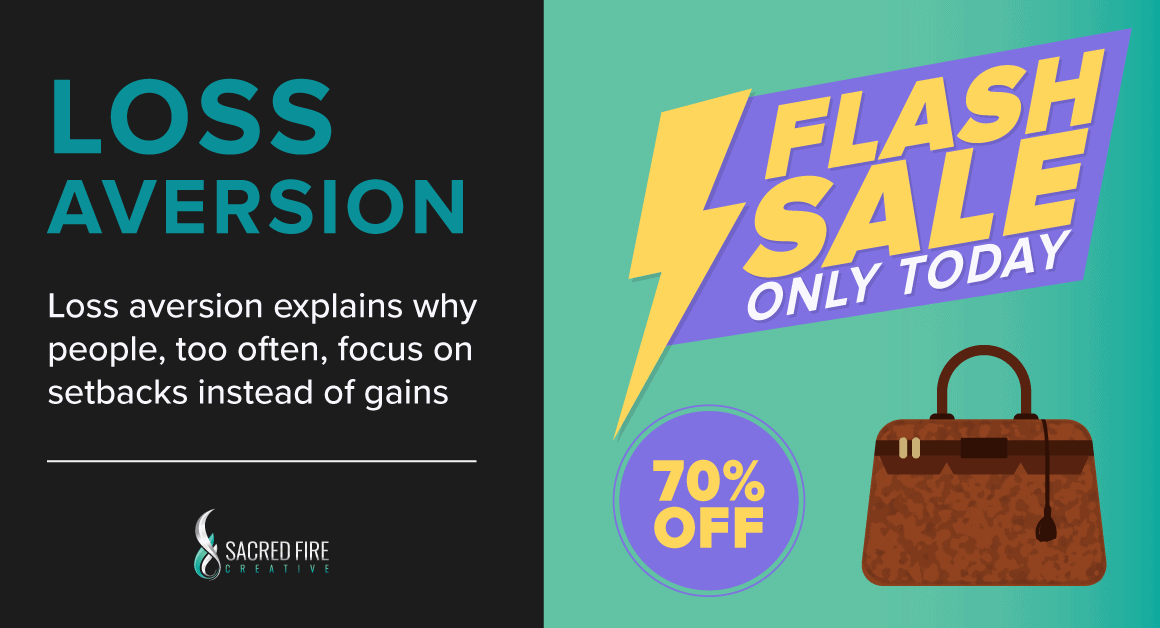
A perfectly executed “flash deal” is a big moneymaker. When a product is deeply discounted for a very limited time, the consumer’s brain focuses on the ticking timer and the amount of savings rather than on the product itself. You probably don’t need another sweater or another cordless vacuum cleaner—but at 70% off, that’s a GREAT deal, right? I can’t miss out on that!

It’s also why pre-orders, coupons, and VIP exclusives work. With pre-orders, it’s an early bird discount—the discount is the prize for ordering early. With coupons, it’s a lot like being given free money. Why would anyone throw free money away, right? With VIP exclusives, all you needed to get VIP status was probably to sign up for a newsletter, and voila! It’s too easy. Why risk missing out on the action?

Free trial periods show people exactly what their life would look like with the product or service, making it exponentially harder for them to end it when the trial is over. They’ve experienced the benefits and identified with that life, so they don’t want to lose it.  

Insurance companies usually have a mile-long list of extremely unfortunate things that could happen to you and how you’ll be negatively affected if you don’t have the proper coverage. No matter how unlikely these events are, they’ve successfully set you up to view them as losses, and you’re more likely to focus on those than the regular payments required to avoid them.

If your business needs to avoid giving people more than necessary, loss aversion tactics can help you sidestep that waste. Studies have shown that when options are presented as addable rather than retractable, people will only take what they want (toppings on a salad, ingredients in a sandwich, etc.).

You can maximize the effects of loss aversion marketing in your small business, too.

The success of your offer entirely depends on your messaging.

Understanding your target audience and their fears is crucial to connecting with them. You need to clearly explain what their life would be like if they don’t purchase your product or service, and they won’t care unless you speak directly to their pain points and experiences. It’s about showing them what they’ll miss out on if they don’t participate soon and painting a picture they can’t ignore.

People must believe there’s something to lose for loss aversion to work properly. If you post an offer for 20% off and claim that it’s only available for the next two days and then post a 25% off coupon the following week, you’ve given people a reason put off making their decision. Even worse, they’ll notice that you contradicted yourself, and any trust they had in you and your brand will start to fade.  

You’re working hard to convert all the “I’ll just buy it tomorrow” shoppers into “I feel good about committing to this now” shoppers. Keep that goal in mind, and you’ll notice a positive trend in your conversion rates.

How about you? How do you leverage on loss aversion? Got a question? Don’t forget to COMMENT below and SHARE your thoughts.

Sources:

https://www.psychologytoday.com/us/blog/science-choice/201803/what-is-loss-aversion

https://www.activecampaign.com/blog/loss-aversion-marketing

https://thedecisionlab.com/biases/loss-aversion/


Ways to Shop and Support the AAPI Community – AAPI-Owned Restaurants

We’ve assembled a list of AAPI-owned restaurants in Portland that are ready and excited to share their outstanding food with you! By ordering meals from these restaurants, you’ll be contributing to their success and possibly opening your eyes to new, delicious flavors. From Thai to Indian and Chinese to Hawaiian, you’ll have plenty of options to choose from for your next take-out night or dine-in experience.

Stabs

Fresh, handmade noodles? Smoked meat on bahn mi? Yes, please.

https://www.instagram.com/stabs_smokedmeats_asianeats/

Mama Dut

Check out Mama Dut if you’re vegan craving for something Vietnamese.

https://www.mamadutfoods.com/shop

Matta

For a nostalgic Vietnamese-American experience.

https://mattapdx.com/menu-1

Kim Jong Grillin

Authentic Korean served hot and fast from a food cart.

https://kjgpdx.com/

Bing Mi

Not your usual crepes. A food cart serving savory, keto-friendly Jian Bing crepes.

https://www.bingmiportland.com/

Bit House Collective

For that playful Filipino dive bar experience.

https://bithousesaloon.com/

Mama Chow’s Chicken

For all your wonton, wings, and garlic noodle cravings.

https://www.facebook.com/mamachowskitchen/

Nong’s Khao Man Gai

Chicken and rice you won’t stop thinking about.

https://khaomangai.com/

Sushi Ichiban

Sushi and Japanese quick-eats for takeout.

https://www.facebook.com/profile.php?id=100056129276079

Toki

The place to go for Korean chicken and comfort food.

https://www.tokipdx.com/

Duck House

Where you can enjoy a Szechuan banquet in style.

https://www.duckhousepdx.com/

Coco Donuts

Handcrafted donuts and coffee like no other.

https://www.cocodonuts.com/

Stretch the Noodle

Servings are huge enough for sharing, totally amazing to eat solo if you’re starving.

https://www.facebook.com/pages/Stretch-the-Noodle/208396859948318

Kim Jong Smokehouse

A harmonious marriage of Korean street food and Southern BBQ traditions.

https://kimjongsmokehouse.com/

Top Burmese

Burmese food with a distinct Pacific Northwest flair.

https://topburmese.com/

Magna Kusina

Old-school Filipino dishes with a fun and modern twist.

https://www.magnapdx.com/

Frank’s Noodle House

Come for the fresh, hand-pulled noodles. Stay for everything else.

http://www.franksnoodlehousepdx.com/

Smokin Fire Fish

Your source for local Hawaiian food.

https://www.smokinfirefish.com/

KaTi

A small vegan/vegetarian restaurant serving big Thai flavors.

https://www.katiportland.com/

Mojo Crepes

For satisfying your craving for Japanese crepes and sweets. Savory is also on the menu.

http://mojocrepes.com/

Thai Fresh

Fresh Thai food, strong community vibe.

https://thaifreshpdx.com/

Kala Noodle and Grill

Curries, boat noodles, stir-fry, pad Thai, oh my!

https://www.kalapdx.com/

Yataimura Maru

Japanese comfort food made from scratch.

http://www.marupdx.com/

K&B Bakery

Serving Portland almond cookies for 27 years.

http://kbbakery.com/

Da Hui

A Hawaiian dive bar with a strong rockability vibe.

https://dahui.bar/

Namaste Bazaar

When you want to experience fine dining on authentic Indian cuisine. Vegan and vegetarian options available.

https://www.namasteindiancusine.com/indian-bazaar

Shandong

Chinese comfort food served family-style.

https://shandongportland.com/

Pai Tong Thai

Just like Grandma’s cooking… if your grandmother’s Thai.

https://www.paitongthai.com/

Red Robe Tea House

For experiencing Chinese-style tea time.

https://www.redrobeteahouse.com/

Chen’s Good Taste

A modern spin on Chinese classics.

https://www.chensgoodtasteor.com/

Mekong Bistro

Authentic Cambodian flavors served this side of the Pacific.

https://www.mekongbistro1.com/

Banh Mi Up

For soothing a craving for Vietnamese, whether it’s a quick bite of bahn mi or pho or a full family feast.

https://www.banhmiuppdx.com/

Dehomis

When you’re peckish for gyoza and other Japanese savory snacks.

https://www.dehomis.com/

JinJu Patisserie

When your K-drama binge makes you hungry for chocolate and pastry.

https://jinjupatisserie.com/

Open Tandoor

Traditional Indian cuisine served Portland casual.

http://opentandoor.com/

This is just a partial list of AAPI-owned restaurants in Oregon. Feel free to explore what’s in your neighborhood.


6 Ways to Shop and Support the AAPI Community – AAPI Art and Museums

Portland is home to some of the most authentic Asian gardens and comprehensive art collections. Taking in visual representations of AAPI culture is an effective way to increase understanding and acceptance. Art has a unique way of bringing diverse communities together and creating a shared experience that unites us. Planning a trip to any of these listed AAPI art museums or exhibits would make for a relaxing afternoon absorbing cultural values and artistry.

Japanese American Museum of Oregon

Formerly known as the Oregon Nikkei Legacy Center, this museum provides physical and virtual opportunities to learn about Japanese American art, culture, history, civil rights, sports, and other topics.

http://www.oregonnikkei.org/

Lan Su Chinese Garden

Considered one of the most authentic gardens outside of China, Lan Su transports visitors to an inspiring wonderland of art, architecture, design, and nature that honors Chinese culture.

https://lansugarden.org/

Portland Chinatown Museum

As Oregon’s first museum showcasing Chinese American history, art, and culture, The Portland Chinatown Museum strives to collect, preserve, and share stories and artifacts that honor immigrant experiences.

https://www.portlandchinatownmuseum.org/

Portland Japanese Garden

This garden was created to share a genuinely peaceful experience with the community, promoting nature, harmony, and the expression of Japanese culture.

https://japanesegarden.org/

Portland Art Museum: Asian Art

With nearly 4,000 objects exhibited, the Asian Art collection at the Portland Art Museum is a constantly growing compilation of artwork mostly gifted by Portland families and individuals.

https://portlandartmuseum.org/collection/asian-art/

Portland Taiko

Having started with a single homemade drum, Portland Taiko is a group that performs traditional Japanese taiko drumming and promotes Asian American creativity and empowerment.

https://portlandtaiko.org/

Exploring AAPI art can be a truly enlightening experience. It’s also an excellent opportunity to support the AAPI community.


5 Ways to Shop and Support the AAPI Community – AAPI Events

Organizations, colleges, businesses, clubs, and other institutions constantly hold events, workshops, webinars, and various celebratory offerings to promote and encourage AAPI support. We’ve compiled a list of options to invite our community to get involved in AAPI advocacy! While this is a particularly challenging year to gather people together, self-education on AAPI history and hardships is increasingly essential due to the rise in discrimination and hate crimes. As resources become more readily available, we have a responsibility to pursue them and become active advocates for the AAPI community. Due to pandemic-related cancellations, we encourage you to add these and other AAPI events to your calendar for the years to come.

AAPI Heritage Month

May is Asian American and Pacific Islander Heritage Month and the perfect time to seek out local and national events celebrating the AAPI community in the United States. Explore social media for some exciting Portland-based participation opportunities!

https://www.nps.gov/subjects/npscelebrates/asian-american-pacific-islander-heritage-month.htm

Voices of Change Celebration

Hosted by the Asian Pacific American Network of Oregon, this event occurs each year during May to honor Asian Pacific American Heritage Month. Community members can gather to enjoy a delightful meal, performances by local artists, a renowned API keynote speaker, the Voices of Change Awards, and fundraising for APANO’s social justice work. Contact them for ticket information or if you’re interested in being a sponsor!

https://www.apano.org/programs/events/

Statewide Convention

The Asian Pacific American Network of Oregon also produces the Statewide Convention. This day-long convention encourages Oregon residents to come together for workshops, networking opportunities, cultural performances, and at least one prominent API keynote speaker. To conclude the day’s work, attendees gather for a banquet celebrating togetherness and inclusion. Reach out to APANO for registration information and sponsor inquiries.

https://www.apano.org/programs/events/

Asian Pacific Islander Heritage Month Celebration

API Forward, a local foundation providing education and leadership training for API students, is turning this event virtual this year so that community members can celebrate this honorary month despite local COVID-19 restrictions. Register for free and help local API students and young professionals become confident, influential leaders in the community.

https://apiforward.org/upcoming-events/

Ongoing Virtual Events Hosted by the Asian/Pacific Islander American Chamber of Commerce and Entrepreneurship

ACE continuously develops online webinars and discussions covering AAPI small business advice, inclusion, resources, and more. Examples include A Conversation with AAPI Small Businesses, Standing in Solidarity: Solutions for Healing and Strengthening New Majority Communities, and Panel Discussion on Federal Resources for AAPI Businesses & Nonprofits. Visit their website to view their calendar of current and future offerings!

https://www.acesmallbusiness.org/events


8 Ways to Shop and Support the AAPI Community – AAPI Organizations

With an increasingly large and diverse population of AAPI members, Oregon needs to continue developing its comprehensive resources for this community. Whether you’re looking to support a dedicated AAPI nonprofit or you’re a member of the AAPI community seeking companionship and assistance, we hope you find this list of primarily local AAPI organizations helpful and inspiring. They rely entirely on community participation, engagement, and donations. Contact them individually to find out how you can best support them and their missions.

Here is a list of Oregon-based AAPI organizations you can support:

Asian Pacific American Network of Oregon (APANO)

The Asian Pacific American Network of Oregon is a statewide, grassroots organization uniting Asians and Pacific Islanders to achieve social justice. We use our collective strengths to advance equity through empowering, organizing, and advocating with our communities.

Backed by the Immigrant Refugee Community Organization in Multnomah County, APANO was founded in 1996 to introduce coordinated leadership in various areas of public policy. Along with the APANO Communities United Fund, they work to unite Asian and Pacific Islanders and attain social justice. Focusing on community organizing, policy advocacy, civic engagement, leadership development, community development, and cultural work, APANO hosts numerous events and opportunities for engagement each year. Participation is cherished, as every dollar donated generates over $90 in community benefits.

https://www.apano.org/

The Rice Bowl Posse

Community, not competition.

In response to increased reports of racism, violence, and hate crimes directed at Asian Americans, five AAPI identifying Portland food cart owners founded The Rice Bowl Posse. Their primary goal is to support each other and other AAPI restaurant owners as they navigate these frightening times. Aron Moxley of Stabs, Thuy Pham of Mama Dut Foods, Richard Le of Matta, Han Hwang of Kim Jong Grillin’, and Jacky Ren of Bing Mi aim to grow support for AAPI owned restaurants and increase accountability.

https://www.pdxmonthly.com/eat-and-drink/2021/04/portland-s-aapi-restaurant-and-food-cart-owners-unite-against-hate-crimes

Asian/Pacific Islander American Chamber of Commerce and Entrepreneurship (ACE)

Our mission is to help AAPI and minority business enterprises survive this pandemic and implement strategies that help them adapt to a changing economy. If you have a business or a nonprofit and need help finding answers, you’ve come to the right place. We’re here to help.

ACE is an information hub geared toward supporting AAPI-owned small businesses. They can assist with accessing funds, government services, health and wellness information, and various support services. Their town hall offers a wealth of knowledge, including services, events, and webinars from their community-based business and civic partners.

https://www.acesmallbusiness.org/

Hapa, Asian, and Pacific Islanders of Portland (HAPI)

Our group commits to the following: forming a professional network with development opportunities; creating a supportive environment for members to exchange ideas and discuss challenges to the HAPI community; advocating to strengthen community inclusiveness through public outreach toward policies, plans, and investments; collaborating with community organizations and institutions on shared goals; highlighting contributions made by HAPI communities.

The HAPI. Affinity Group collaborates with the city of Portland to advocate and educate on behalf of HAPI employees, strategizing ways to attract, support, and retain them. They use the term “Hapa” to represent multiracial individuals of Asian or Pacific Islander descent.

https://www.portlandoregon.gov/71327

Immigrant and Refugee Community Organization (IRCO)

Our vision is to be a leader of community-driven, innovative programs delivered by compassionate staff who create equitable services that empower immigrants, refugees, and underserved communities.

With over 200 culturally and linguistically specific social services, IRCO empowers Oregon’s immigrants, refugees, and community members to build new, self-sufficient lives. They work to help individuals and families thrive through programs that nurture understanding, compassion, and communication between Oregon’s established communities and those being introduced.

https://irco.org/

Japanese-American Society of Oregon (JASO)

Our mission is to develop business and community by strengthening the US-Japan relationship.

JASO is the third oldest Japan-American Society in the United States (1907). It is comprised of corporations and individuals in Oregon and Southwest Washington that are passionate about enhancing the connection between the US and Japan. These enthusiastic advocates form volunteer committees that lead programs in business, education, and culture.

https://jaso.org/

Kalakendra, Society for the Performing Arts of India

Our mission is to introduce, promote, and enhance awareness of the various performing arts of the Indian subcontinent through concerts, classical dances, recitals, and lecture demonstrations.

Kalakendra contributes to the area’s cultural activities and cross-cultural understanding through sharing performing art forms of India. Founded in 1987, they feature internationally acclaimed artists and local talent, providing programs that attract a diverse community audience.

https://www.kalakendra.org/

Philippine American Chamber of Commerce of Oregon (PACCO)

Welcome to a diverse community that promotes economic justice and empowerment for Filipinos, Native Americans, Black, Indigenous, and all People of Color. We create a positive impact on Filipino businesses and the Oregon Economy.

PACCO’s goals focus on racial equity, including promoting entrepreneurism, education, professional growth, civic engagement, and business development. They prepare the next generation of Filipino leaders in a variety of ways. These include scholarships, leadership training programs, board involvement, technical assistance, community volunteerism, and relevant workshops.

https://www.pacco.org/

These are just five AAPI organizations in Oregon. We invite you to do your own research and support the AAPI organizations that are most aligned with your beliefs.


Ways to Shop and Support the AAPI Community

How can we support the AAPI community during and beyond AAPI Heritage Month? We listed here a few suggestions.

1) Donate to AAPI organizations to help them reach their goals.

With an increasingly large and diverse population of AAPI members, Oregon needs to continue developing its comprehensive resources for this community. Whether you’re looking to support a dedicated AAPI nonprofit or you’re a member of the AAPI community seeking companionship and assistance, we hope you find this list of primarily local organizations helpful and inspiring. They rely entirely on community participation, engagement, and donations. Contact them individually to find out how you can best support them and their missions.

Read more: AAP Organizations

2) Participate in AAPI events to further your knowledge and understanding of the community’s history and hardships.

Organizations, colleges, businesses, clubs, and other institutions constantly hold events, workshops, webinars, and various celebratory offerings to promote and encourage AAPI support. We’ve compiled a list of options to invite our community to get involved in AAPI advocacy! While this is a particularly challenging year to gather people together, self-education on AAPI history and hardships is increasingly essential due to the rise in discrimination and hate crimes. As resources become more readily available, we have a responsibility to pursue them and become active advocates for the AAPI community. Due to pandemic-related cancellations, we encourage you to add these and other AAPI events to your calendar for the years to come.

Read more: AAPI Events

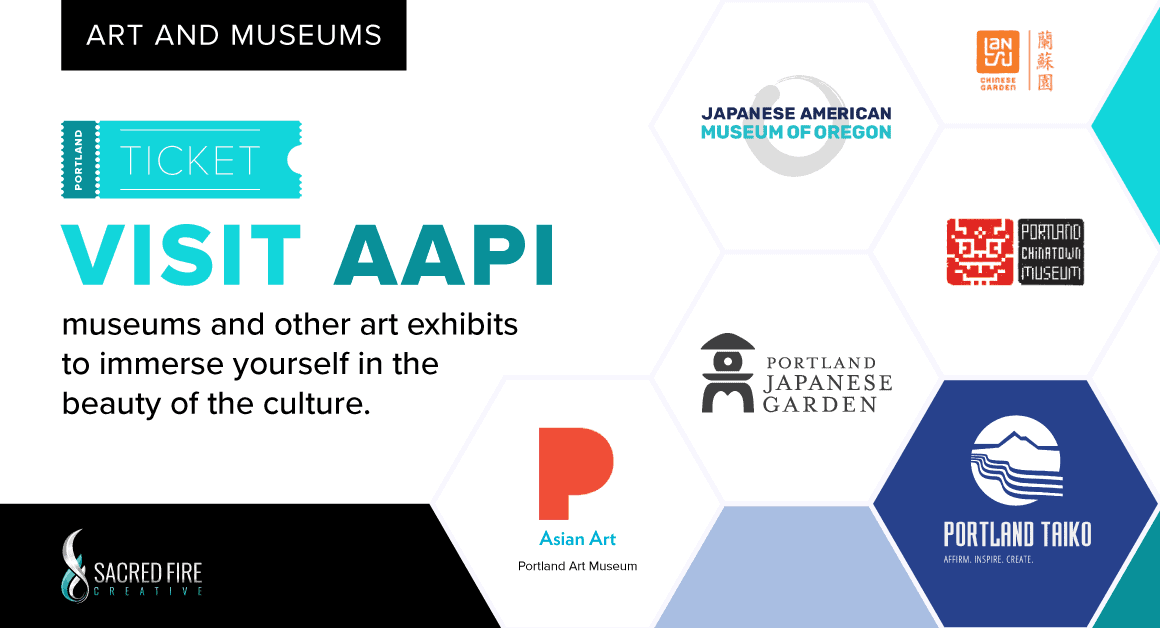
3) Visit AAPI museums and other art exhibits to immerse yourself in the beauty of the culture.

Portland is home to some of the most authentic Asian gardens and comprehensive art collections. Taking in visual representations of AAPI culture is an effective way to increase understanding and acceptance. Art has a unique way of bringing diverse communities together and creating a shared experience that unites us. Planning a trip to any of these listed AAPI museums or exhibits would make for a relaxing afternoon absorbing cultural values and artistry.

Read more: AAPI Art and Museums

4) Order food from AAPI-owned restaurants to help them thrive.

We’ve assembled a list of AAPI-owned restaurants in Portland that are ready and excited to share their outstanding food with you! By ordering meals from these restaurants, you’ll be contributing to their success and possibly opening your eyes to new, delicious flavors. From Thai to Indian and Chinese to Hawaiian, you’ll have plenty of options to choose from for your next take-out night or dine-in experience.

Read more: AAPI Restaurants

5) Shop at AAPI-owned stores to boost their business.

There is no shortage of AAPI stores in the Portland area, including grocery, clothing, and home goods shops. Whether you’d like to go in for an immersive experience or order online, these businesses will be extremely grateful for your support. Gather special ingredients to make a traditional meal or purchase small gifts to give your loved ones for the next holiday! You’re sure to find some unique treasures in these shops.


Supporting Portland’s AAPI community must be a year-long thing, not just during AAPI Heritage Month. We encourage you to explore Portland and enjoy the richness and complexity that AAPI culture brings to the city.


Privacy Settings
We use cookies to enhance your experience while using our website. If you are using our Services via a browser you can restrict, block or remove cookies through your web browser settings. We also use content and scripts from third parties that may use tracking technologies. You can selectively provide your consent below to allow such third party embeds. For complete information about the cookies we use, data we collect and how we process them, please check our Privacy Policy
Youtube
Consent to display content from Youtube
Vimeo
Consent to display content from Vimeo
Google Maps
Consent to display content from Google