Articles Tagged with: women in business

Empowering Rural Communities: The Inspiring Journey of MEDP’s Patty Herzog in Economic Development

Sacred Fire Creative is proud to support and highlight women founders, entrepreneurs, and leaders who are making a profound impact on their respective communities.

In this edition, we focus the spotlight on Patty Herzog, Executive Director of the McMinnville Economic Development Partnership.

Patty’s story is one of passion and dedication to rural economic development. With over 20 years of hands-on experience across both public and private sectors, she spent her career building up communities and creating opportunities in often overlooked areas. From her early days as a small business owner to her current role leading MEDP, Patty strives to make an impact with her work.

Today, Patty guides MEDP as the organization focuses on building up and supporting McMinnville’s manufacturing sector. More than 100 manufacturing companies call McMinnville home and contribute significantly to the local economy. By creating more than 2,200 individual jobs and generating $338 million in revenue, McMinnville manufacturing adds substantially to Oregon’s GDP.

MEDP’s efforts to boost local manufacturing are highly visible in the ongoing “Coolest Thing Made in Yamhill County,” a competition designed to showcase the industry’s vibrancy. Of the 32 entries, homegrown companies Applied Physics Technologies and Blue Raeven Pies rise up as finalists.

MEDP also recently hosted its annual awards, where they honored bespoke bar manufacturer EMPWR Nutrition for expanding their facility and creating 200 new jobs, Phenix Solutions for developing their Ultra 2XL aircraft, and HelloCare for building a 100-strong team providing much-needed caregiving services in the region.

To further boost and support McMinnville’s labor force, MEDP is hard at work completing its Sustainable Workforce Training and Resources project. A collaboration with the local government, the project provides skills training and resources, as well as hosts hiring, internship, and training programs.

MEDP is also on the Advisory Board of Launch Mid Valley (LMV), the regional innovation hub for the counties of Polk, Yamhill, and Marion. Through LMV, Patty and MEDP lend their expertise and experience in supporting the region’s startups and entrepreneurs.

Patty extends her dedication to serving the community outside of her professional roles. She is a member of the Chemeketa College Foundation Board and the McMinnville Public Arts Commission. She also recently joined the Willamette Workforce Partnership.

Patty Herzog’s and MEDP’s journey is an inspiring reminder of the power of targeted economic development in building stronger, more connected communities. Her work paves the way for growth, and we’re excited to see how her vision will continue to influence the shaping of McMinnville’s future through MEDP.



SFC Congratulates Pallavi Pande of Dtocs LLC for Placing in SEED SPOT’s Retail Brand Accelerator

Green, sustainable, environment-friendly – these are just some buzzwords that brands often use to market their products to eco-conscious consumers.

Unfortunately, the reality is that not all brands that spout these words actually walk their talk.

Not Pallavi Pande, though – she’s an entrepreneur who really walks her talk. As the founder of Dtocs LLC, she produces disposable tableware that is 100% safe for the environment. The production process itself is sustainable and supports communities in the US and India, Pallavi’s home country. 

So, it’s not surprising that Pallavi has secured a place in SEED SPOT’s Retail Brand Accelerator. It’s training that will take her brand far and strengthen Dtocs LLC’s community impact even more.

Congratulations, Pallavi!

SEED SPOT empowers founders to succeed in the mass retail market.

The SEED SPOT Retail Brand Accelerator is a dynamic program designed to nurture established founders looking to scale their business in mass retail. The program focuses on founders in the consumer-packaged goods market and provides them with an intensive 10-week training.

This training helps participants refine their sales approach, expand their supply chain and inventory capacities, comply with regulations, and build a standout brand. Virtual workshops and personalized one-to-one mentorship make up the bulk of this training.

The Retail Brand Accelerator is funded by the Walmart.org Center for Racial Equity, Walmart’s philanthropic endeavor to uplift BIPOC communities in education, finance, health, and criminal justice.

Dtocs LLC offers more than just sustainable tableware.

With Pallavi joining the SEED SPOT Retail Brand Accelerator, it’s clear that her Dtocs LLC brand is headed for growth. And if there’s a company that should grow as big as it can and gain as much attention as possible, it’s Dtocs LLC.

Why? It’s because the company greatly impacts the community it serves.

Dtocs LLC manufactures single-use tableware. But they’re nothing like the disposable tableware we see in supermarkets, typically made with plastics and other toxic materials.

Here’s why they’re different:

  1. They’re made using the fallen leaves and shed sheaths of Areca palms. These are usually considered waste materials. Instead, the local farmers in India with whom Dtocs works collect them to be processed into tableware. No part of the living Areca palm is harmed or cut during the process.

  2. They’re processed using an eco-friendly system. From drying to shaping to packaging, the process that these Areca shedding goes through to become single-use tableware poses no harm to the environment. Renewable energy sources power the machines used. The raw materials are cleaned with fresh water. The products are packed with sustainable cardboard.

  3. They’re durable and stylish. Many factors prevent the typical consumer from using eco-friendly disposable tableware. Many consider them not as durable as plastics. People who are conscious of plating and dining table aesthetics may not like how these disposables look. Because they’re made with Areca palms, Dtocs tableware doesn’t crumble easily, even when holding liquids. They also come in stylish shapes and forms.

  4. They’re biodegradable. After you’ve used these palm-leaf dinnerware, you can safely throw them in the bin or even add them to your compost. They will degrade in a few days. So they won’t contribute to the growing garbage problem that the world is facing today.

Their products are not the only things that set Dtocs LLC apart. The company employs women artisans in India to manufacture their products, empowering them to provide for their families and live better lives.

Additionally, Dtocs LLC uses a portion of its earnings to give back to its communities. They’ve partnered with non-profits in India to provide livelihood for women and fund the education of underprivileged children. They also contribute towards equal education opportunities for underrepresented students in Portland. 

Pallavi Pande is an inspiration to women entrepreneurs.

Without a doubt, Pallavi embodies the definition of a successful business owner. Her company is thriving and scaling for further growth. Her brand is solid and gaining recognition. And she fulfills her role as a leader by giving back to her communities.

Pallavi’s achievements are more remarkable because she did all of these as a woman from a minority group. While much has been accomplished to secure women’s place in business in the last few decades, it goes without saying that women entrepreneurs still face challenges that men don’t. The stakes get even higher when she is also a woman of color.

Pallavi overcame these challenges. A self-described mompreneur, she also found a way to balance building a successful company and nurturing a family. That’s not an easy feat.

We salute and congratulate Pallavi Pande of Dtocs LLC for her current and future successes. She’s someone we can all admire and emulate, no matter what stage we are in our respective entrepreneurial journeys.

Sacred Fire Creative helps women business owners maximize their entrepreneurial potential through innovative digital marketing strategies and authentic relationship-building with their audiences. Contact us today, and let’s see how we can collaborate.


Little Nestlings Early Learning Center to Be Featured on KOIN

What do you do when a good friend tells you they will be on TV? You get excited for them and save the date of their appearance on your calendar, of course.

Well, that’s what the Sacred Fire Creative team feels right now. We’re so thrilled to announce that our client, Little Nestlings Early Learning Center, will be featured on the KOIN network soon.

The details are still being worked out, but we can’t wait to see Colleen Cleary and the Little Nestlings team on TV. Stay tuned!

At Little Nestlings, the environment plays an essential role in learning.

Little Nestlings Early Learning Center is a new preschool that opened in Fall 2024 in West Linn, Oregon. Headed by veteran educator Colleen Cleary, the school offers a curriculum inspired by the Reggio Emilia philosophy.

In the Reggio Emilia philosophy, children are seen as capable of directing their learning, and the environment acts as a teacher. The little ones are encouraged to be curious, explore their surroundings, observe their senses, and ask questions. Much of the study time takes place outdoors.

Through this model, children get to develop a sense of discovery and a deep love for learning. They get to build a solid foundation that will serve them throughout their school years and later in life.

Little Nestlings’ TV appearance is part of an ongoing branding campaign.

We’re happy to say that Little Nestlings’ upcoming TV appearance results from Sacred Fire Creative’s ongoing campaign to bring awareness to the school’s brand.

Since early 2024, we’ve been on a multi-tier marketing campaign for the school. This campaign included designing and search-optimizing their website and populating their social media channels. We’ve also been conducting mainstream media and community outreach. 

We believe in the impact that Little Nestlings Early Learning Center will bring to early education and the community as a whole in West Linn. It’s an honor for us to be part of their journey.

Your brand is your legacy. At Sacred Fire Creative, we can help you build a legacy that will leave a lasting and positive impact on your community. Contact us today and discover how we can collaborate.


Breaking Barriers: How US Womxn Entrepreneurs Can Overcome These 4 Common Business Hurdles

Hurdles are nothing new to womxn entrepreneurs in the US. While we’ve come a long way from challenges like needing our husbands’ or fathers’ signatures for loan or credit applications thanks to the Women’s Business Ownership Act of 1988, we still have some ways to go to secure our seats at the table. Still, with passion and determination, womxn business owners can overcome any obstacle on their path to success.

Let’s look at four common hurdles that womxn entrepreneurs typically face in the business arena. More importantly, let’s examine how we can get over them

Hurdle #1: Lack of Access to Capital

One of the biggest obstacles to any womxn entrepreneur’s success is lack of access to capital. Without funding or resources, we can’t build, much less grow, a thriving business.

As of 2019, women-owned businesses have created 10.8 million jobs in the US. They’ve also generated $1.8 trillion in earnings. And yet, in 2022, some 25% of women entrepreneurs have had their business loan applications denied compared to 19% of men. In 2023, only 28.4% of loans backed by the US Small Business Administration went to women-owned companies. As for venture capital funding, women-owned businesses received only 2% of the total capital invested by the end of 2023. 

We’re clearly looking at a considerable gap in capital access for womxn entrepreneurs here. This is why many opt to self-fund their businesses by dipping into personal savings, using their personal credit cards, or with the help of family and friends.

But self-funding isn’t a choice that everyone can make. If that’s your case, here are options you can explore to raise capital for your business:

  1. Check out resources like Access to Capital Directory for Entrepreneurs by Bank of America.
  2. Set up crowdfunding campaigns through sites like Kickstarter and IFundWomen.
  3. Find women-led investment groups like Broadway Angels and TrueWealth Ventures.
  4. See what funding avenues are available at your local SBA Women’s Business Center.

 Nina Vaca: Starting a business with $300

As the CEO of Pinnacle Group, Nina Vaca is one of the rare Latina leaders in the male-dominated IT industry. Her father’s death in the late 1980s compelled her to take over his travel agency at age 17. In 1996, when she was 25 years old, Nina started Pinnacle in her living room with only $300 in her pocket as a way to expand her family’s network. Today, Pinnacle is a billion-dollar company and one of the biggest workforce solutions providers in the world. It’s also one of the fastest-growing woman-owned businesses in the US.


Hurdle #2: Gender Bias and Stereotypes

Getting funding is challenging for women business owners because of two huge factors: 1) the prevailing stereotypes our society has formed for females and 2) the gender bias that grew from these stereotypes.

A 2018 study showed that white male-dominated investing companies tend to look at the applicant’s gender when considering business pitches. These investors often see women-owned businesses as riskier. They also judge female applicants based on the quality of their pitches and their confidence in delivering them.

Another 2018 study found that male investors usually perceive that the venture has a higher risk of failure if a woman’s business is in a male-dominated industry.

And then, there’s the age-old debate about women and emotional labor. Women are expected to bear the brunt of the labor at home. According to this article, traditional financiers are likely to deny loans to women business owners who are mothers and homemakers. The common belief is that CEOs who are also moms won’t be able to prioritize growing their companies. 

Lastly, we have the common gender perception that women are emotional and, therefore, lack the assertiveness necessary for leadership. While this characteristic is now seen as empathy, being more in tune with their emotions is still seen as a negative for women entrepreneurs in some circles.

Gender perceptions are learned, so it will take time for society to completely change how women are seen. We need to fight our small and personal battles in this arena. Here are some strategies we can adopt to win these battles:

  1. People don’t know what you know. Explore ways to position yourself as an expert in what you know.
  2. In a room full of colleagues and peers, don’t wait for others to introduce you as the expert in what you know. Introduce yourself.
  3. Surround yourself with a tight circle of diverse advisors and mentors, not just women. Having male advisors will give you an insight into why men in your industry behave the way they do. 
  4. Build your social capital and plug into business networks in your area, such as your city’s chamber of commerce or local NAWBO chapter. 

Mariyah Saifuddin: Setting the stage

Innovative Solution Partners CEO Mariyah Saifuddin often finds herself the only woman in the room whenever she meets with colleagues. The experience made her an expert at setting the tone whenever she enters a room. She does this by introducing herself as the owner of her company and showing what she brings to the table as an IT professional. She doesn’t wait for anyone else to make introductions for her.


Hurdle #3: Work-Life Imbalance

Prevalent gender stereotypes also contribute to another hurdle that women business owners typically experience: the lack of work-life balance. As mentioned earlier, women are expected to shoulder the brunt of emotional labor. They’re traditionally seen as the primary caregivers for their families and households.

A San Diego, CA-based study in 2023 found that the participating women struggled to balance the demands of caring for their children and running their businesses. This was especially true during their early years of operations. Ironically, the participants shared that they started their own business to have more time for family.

Why do women business owners need to balance their personal and professional lives? For one, it helps us stay healthy physically and mentally. It’s all too easy to get caught up with the demands of running a business. If we don’t keep this balance, we’ll soon be headed for burnout.

Another is it gives us a sense of fulfillment, especially regarding relationships. Maintaining balance allows us to strengthen and enjoy our relationships with family and friends. It also makes space for us to relish the fruits of our labor.

Yet another reason is it keeps us productive and creative. Time away from work helps us relax and recharge. We can do more when rested and process information more effectively when our minds have had time to unwind.

How can we create a balance between our professional and personal lives?

  1. Build a team to support you. Having a team to whom you can delegate tasks can free up much of your time and energy. This lets you focus on what matters instead of getting tied up with the day-to-day. Even hiring a part-time virtual assistant to, say, manage your emails and phone calls can make a difference.
  2. Explore childcare options. If you need to attend to tasks without getting distracted by your kids, check out available childcare options. Your spouse or a family member can look after your kids while you work. You can also sign up for daycare or get a babysitter.
  3. Set boundaries. Setting boundaries will prevent you from getting too caught up with the demands of your business. This can be as simple as limiting your work time to certain hours. On the flip side, you may need to impress upon your family that you can’t be distracted during your work time unless necessary.
  4. Schedule some me-time. You can’t pour from an empty cup. Keep your cup refilled by setting aside time for yourself – for meditating, exercising, working on a hobby, reading a book, or even lolling in bed and doing nothing.

Queirra Fenderson: Building your business around your life

Business coach and The Ambition Studio founder Queirra Fenderson talked about building your business around what’s going on in your life. She shared that when she and her husband were trying to get pregnant through IVF, she reorganized her work around her doctors’ appointments and prioritized self-care. She stressed the importance of identifying the life you want to lead and structuring your business around it.


Hurdle #4: Limiting Beliefs

Perhaps the biggest hurdle that womxn business owners face is their own limiting beliefs. If you see yourself in a negative light, you’re restricting your potential.

It can’t be stressed enough how important it is to have faith in our abilities. When we have a strong self-belief, we empower ourselves to overcome the obstacles to our success. We become resilient enough to push against the challenges ahead. We can trust our judgment and decisions and take the risks we need to grow.

Plus, a strong self-belief negates the impostor syndrome that can keep you from celebrating even your smallest wins. When you believe in yourself and act on your beliefs, you win your team’s and peers’ respect, and you can inspire others with your story.

How can you overcome your limiting beliefs?

  1. Journaling. Writing your thoughts and feelings in a journal can help you identify and question your limiting beliefs. Ask yourself why you believe or feel the way you do. Analyze your behavior and what triggers them.
  2. Reframe your beliefs. Once you’ve identified your limiting beliefs, find a way to reframe them into empowering statements about yourself. Instead of saying, “I can’t do this,” tell yourself, “I am capable of learning how to do this.” Also, list the values you want to believe you have, visualize yourself achieving success through them, and affirm yourself daily with them.
  3. Set smaller and achievable goals. While setting big and lofty goals is exciting, you may reinforce your limiting beliefs if you don’t achieve the expected results. Set the bar within your reach. Celebrate once you’ve reached the goalpost, and then take one step out of your comfort zone and set another goal.
  4. Get support. Having someone to talk to and be accountable for your limiting beliefs helps a lot in overcoming them. That someone could be your spouse or partner, a trusted family member, a close friend, or maybe your therapist or life coach. Hearing yourself talk to someone about how you see yourself can be enlightening. You can also gain perspective when you hear someone else’s thoughts about you and how you’re doing. 

Nicole Chamblin: Knowing your worth

Leadership and productivity coach Nicole Chamblin shared that doubt is the biggest challenge she must continually go through. She said it’s easy to compare ourselves with others and allow the negative voices to creep into your head because of these comparisons. Knowing your worth and reminding yourself frequently of your worth are powerful weapons against self-doubt.

Hurdles are nothing new to womxn entrepreneurs in the US. We’ve come so far, and we still have a lot of challenges along the way. But as long as we are determined to overcome these hurdles, we can achieve our success stories.


Josie Natori: Filipino Fashion Trailblazer

“I just don’t like to settle. Good enough is never good enough.” – Josie Natori

Josephina Almeda Cruz, also known in fashion circles as Josie Natori, is considered one of the most outstanding women business owners in the Philippines. This Filipino-American entrepreneur runs The Natori Company, an international women’s fashion brand. Her products retail in the U.S.’s most prominent department stores, including Saks Fifth Avenue, Bloomingdales, and Neiman Marcus. Her products are available worldwide today through her brand’s website

All in the family

Josie grew up in a matriarchal society surrounded by her close-knit Filipino kin. “Women are encouraged to be entrepreneurs,” Josie says of her family. This encouragement stayed with her throughout her life. Even when she was a child, her grandmother would remind her that she should never be in a position where she had to depend on anyone. This upbringing gave her the motivation and inspiration to start her own business.

When she was younger, Josie didn’t plan to enter the fashion industry. Artistically talented and naturally inclined to play the piano, Josie performed in a solo concert with the Manila Philharmonic Orchestra. She was only 9 years old. At 17, she left for New York and pursued an economics degree from Manhattanville College. 

From banking to fashion

After graduation, Josie embarked on a career in banking. Eventually, she became the first female vice president of investment banking at Merrill Lynch. There, she met and married Ken Natori, a fellow executive in the banking world. She then gave birth to her son Kenneth Jr. in 1976,

The following year, Josie found herself looking for new challenges and wanting to start her own business. Before entering the fashion industry, Josie opened several different ventures, from a McDonald’s franchise to a carwash.

Josie’s namesake company began when she brought an embroidered garment from the Philippines to a buyer in Bloomingdales. The buyer advised her to turn it into a sleep shirt; the rest was history.

In the early years of The Natori Company, many of Josie’s friends and relatives pitched in to help her make her vision a reality. For example, an uncle pitched in to sew labels onto clothes. Other family members once gathered to help make a small trim cut on a special order of a thousand blouses. In 1985, Josie convinced her husband, who was still working on Wall Street, to help run her growing business. He became chairman of The Natori Company.

An international empire

More than four decades later, The Natori Company has transformed into a lifestyle brand that includes popular lingerie collections, ready-to-wear apparel, home items, eyewear, and fragrance. Aside from being the founder of an internationally successful fashion business, Josie works to give back to society. She sits on the board of several organizations, including the Asian Cultural Council and the Fashion and Design Council of the Philippines. Her factory in the Philippines handles over 60% of her company’s production and employs 500 workers.

Josie Natori is an admirable example of a woman who pursued her dreams and achieved success with the help of family and friends. From a single sleep shirt, she has built an international empire now seen as one of the world’s top lifestyle brands. “Now, as the company grows, we grow our sensibility too, taking our concept and making it a whole world. As we say here, Natori is ‘where life meets art,’” she shared.

Sacred Fire Creative honors visionary women who forged their own path to success in this #WomenWhoMatter series. If you see yourself as a visionary, who wants to create a lasting, positive impact on your community, come work with us.


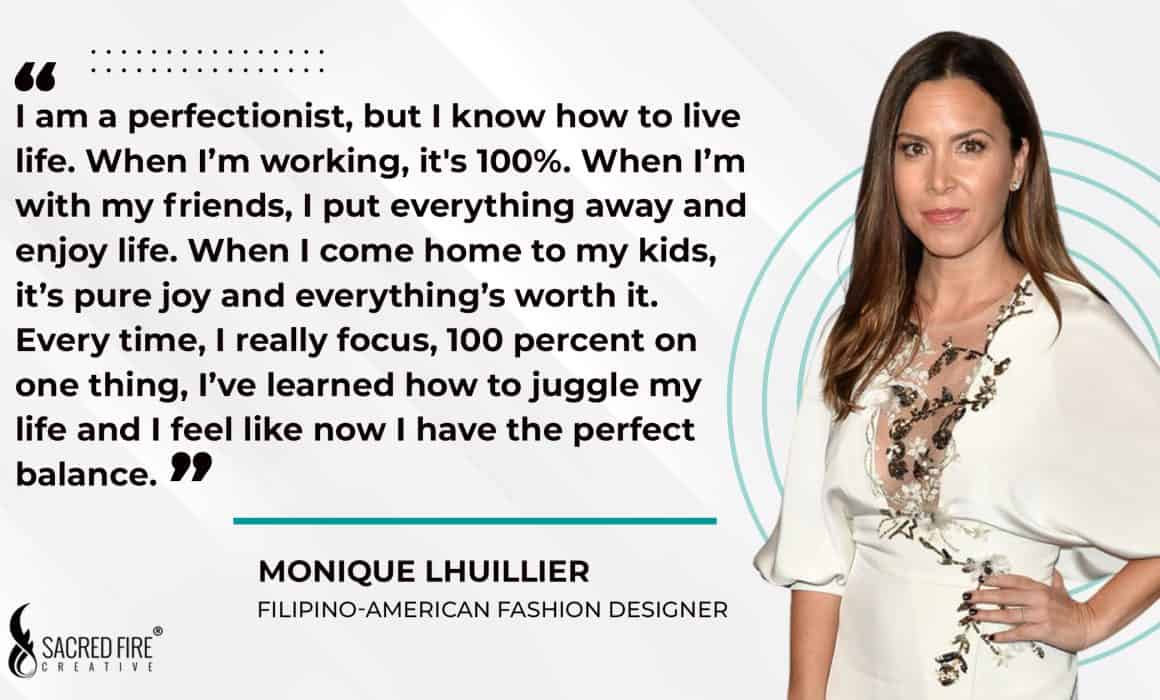
Monique Lhuillier: Elegance for the Everyday Woman

“I am a perfectionist, but I know how to live life. When I’m working, it’s 100%. When I’m with my friends, I put everything away and enjoy life. When I come home to my kids, it’s pure joy and everything’s worth it. Every time, I really focus, 100 percent on one thing, I’ve learned how to juggle my life and I feel like now I have the perfect balance.” – Monique Lhuillier

What do Taylor Swift, Michelle Obama, and Reese Witherspoon have in common? They’ve all worn Monique Lhullier’s creations. The Filipino-American fashion designer has made a mark on the fashion industry with her sophisticated, feminine, and glamorous ready-to-wear and bridal collections. 

From regular brides to famous celebrities, most women have heard of Monique Lhuillier. Her brand is synonymous with elegant and timeless feminine designs, whether in dresses or houseware. The renowned fashion designer has been a member of the Council of Fashion Designers of America since 2003. Since then, she has ventured into fragrance, jewelry, and various partnerships with other brands, such as Pottery Barn.

Monique was born in Cebu City, Philippines, in 1971. She spent her childhood in the Philippines before attending boarding school in Switzerland at 15. Monique loved fashion at an early age, and after leaving Switzerland, she attended the Fashion Institute of Design and Merchandise in Los Angeles. This school is where she met her husband, Tom Bugbee, who also became her business partner. Aside from being her life partner and father to her children, he has also helped her build her business empire.

She began designing wedding gowns in 1996 when she was preparing for her own wedding and couldn’t find anything she liked. Although she eventually found a wedding gown from another designer, this event sparked her motivation and interest in the fashion industry and began a successful fashion career.

Thanks to Monique and her elegant brand, women worldwide have access to sophisticated styles that are designed for a woman by a woman. Whether it is a milestone event like a wedding, or everyday pleasures, like wearing a favorite perfume, Monique Lhuillier continues to add beauty to women’s lives.

Sacred Fire Creative honors women who make a difference in everyday life. Contact us to learn how you can make a difference through your own business.


3 Key Leadership Lessons from Women CEOs

Did you know that, as of 2018, 12.3 million businesses in the U.S. are women-owned? That’s roughly 42% or four out of 10 of all companies in the country. Interestingly, these women-led enterprises generate around $1.8 trillion in earnings every year.

Judging by these figures, the current notion that men are better at leadership and women should emulate them is becoming obsolete. Women generally have a distinct leadership style that their male peers can actually learn from.

What leadership lessons can we learn from female CEOs? Let’s spend some time pondering these three:

Know your strengths and limitations.

Women tend to be more self-aware, and they’re usually not prone to bluster. This tendency for self-awareness gives women a deeper insight into their own strengths and limitations. They build on their capabilities and lean on others to make up for their weaknesses.

What does this mean for you? If you want to be a good leader, you need to learn more about yourself. Know the traits that make you strong and acknowledge your weak points. Use your strengths to grow your business and surround yourself with a competent and inspired team to make up for your limitations.

“It’s OK to admit what you don’t know. It’s OK to ask for help. And it’s more than OK to listen to the people you lead.” – Mary Barra, General Motors CEO

Put your team first.

Women are often stereotyped as too compassionate and relationship-oriented to be competent leaders. But the fact is that these traits are now seen as indicators of high emotional intelligence, which in turn has become a desirable trait among leaders.

As mentioned earlier, a woman business leader tends to surround herself with a team to augment what she lacks. But this relationship is rarely one-sided. Female leaders often serve as mentors and cheerleaders to their team. They encourage and empower their team to grow professionally and personally through validation and empathy.

“I think about: ‘Have I been bringing enough people along?’ You can help a peer become a CEO… This is not a competition or a race.” – Rosalind Brewer, former CEO of Walgreens

Be a transformational leader.

Perhaps one of the best leadership lessons we can learn from a woman CEO is the art of transformational leadership. A transformational leader is someone who leads by example. Their sense of purpose and values inspire their followers to change their own beliefs, bring out their best selves, and positively impact their world. Women CEOs tend to be gifted transformational leaders.

How can you become a transformative leader? It starts with yourself. You need to be a model of integrity and principle. You have to have a clear vision and measurable goals. And you have to win your team’s trust, be ever-reliable, and inspire them to serve the higher good rather than their self-interest.

“Leadership is service to others.” – Denise Morrison, Campbell Soup Co. President and CEO

These are only a few leadership lessons we can learn from women CEOs. Spend some time meditating on these lessons and see how you can apply them to your own business.

Sacred Fire Creative is a digital marketing agency that positions itself as a force for good. Reach out to us today and let us help you build a solid, authentic brand that matters to your audience.


Material Change Institute: Diversifying Capital Investment One Cohort at a Time

The investment industry has one glaring issue – it’s predominantly white and male. Given the role that investments play in driving economic growth, the fact that the industry lacks racial and gender diversity can be detrimental for women and people of color. Most of the time, they simply can’t get in the door.

Material Change Institute is set to change that. Helmed by woman investor and entrepreneur Eve Blossom, this new non-profit provides women and BIPOC professionals the skills and connections they need to succeed as investors.

Material Change Institute offers training for would-be investors.

Material Change Institute equips would-be investors from minority and underrepresented groups with the essential knowledge and tools for getting started in investment. It offers a 12-month executive program called the Material Change Fellowship.

Through the Material Change Fellowship, professionals receive training in leadership and strategic skills for different forms of investing. They also get access to mentors, peers, and partner funds that can help them apply their learnings practically. Hybrid training modes – internships, cohort-based learning, and online modules – are available. As of this writing, Material Change Institute only accepts fellows with at least five years of professional experience.

Eve Blossom aims to change the landscape of investing.

Material Change Institute founder Eve Blossom is set on transforming what the investment industry looks like. As she said in this article, “[D]isruption is needed when a system is not inclusive, does not apply different perspectives that would increase the opportunity and wealth for all of us.”

She has a point. A 2019 study revealed that women- and minority-led investment firms manage only 1.3% of the world’s assets. The worldwide asset management industry is worth US$89 trillion as of 2019. Additionally, a 2022 report found that the venture capital workforce is only 4% Black and 5% Hispanic/Latinx, though 45% is female.

Through its training program, Material Change Institute is opening the doors to investment for more women and people of color to come through. We can look forward to when the industry is not so white or male anymore.


Sacred Fire Creative is a Portland, OR-based digital marketing agency that aims to promote good in the world. Work with us to strengthen your brand’s connection with your audience and become a force for good.


4 Proven Ways Your Personal Brand Can Dominate 2022

The business world is changing. Human connection is becoming an increasingly essential element of business success, and as a further result, the role of personal brands in the world of business is evolving. And make no mistake about it, personal branding is no longer just for CEOs. Instead, it’s for every individual who wants to build their brand, grow their social presence and have a profound impact on their community.

Personal branding is the process of building a unique image that recognizes your talents, credibility, skills, and goals—looking to start building your personal brand in 2022? Here are four tips to help you dominate 2022!

1. Establish your value

When you build a personal brand, the value you can deliver to people through your work shapes the content you create and the type of audience you engage. When it comes to marketing, value is king. To help establish trust with your audience, focus on delivering excellent content around your audience’s pain points.

2. Be crystal clear

Before investing heavily into your personal brand, make sure you’re crystal clear on what you want to be known for, who your audience is, and where you’re going. Your true calling will help you determine your niche, create a cohesive message around it, and then build an audience cheering for you.

3. Don’t be boring

Everyone is trying to get the same message across. That dull, generic content doesn’t cut it anymore. Surprise your audience with something new and different, and give them a reason to stick around. You’ll get the reward, attention, and success you deserve if you do.

4. Keep it real

Social media is supposed to be a place where people can connect, but all too often, it’s filled with false attempts at self-promotion. Remember that trust between you and your audience is so much more valuable. Every time you put yourself out there, you build trust and connection. Leaders tell their true stories transparently and authentically, and at the end of the day, people only care about one thing: The real you and your message!

With a little preparation and strategy, you can build your personal brand the right way. Start by understanding these four elements and get ready to change the world!


Privacy Settings
We use cookies to enhance your experience while using our website. If you are using our Services via a browser you can restrict, block or remove cookies through your web browser settings. We also use content and scripts from third parties that may use tracking technologies. You can selectively provide your consent below to allow such third party embeds. For complete information about the cookies we use, data we collect and how we process them, please check our Privacy Policy
Youtube
Consent to display content from Youtube
Vimeo
Consent to display content from Vimeo
Google Maps
Consent to display content from Google