Articles Tagged with: Willamette Valley

Newberg’s Real Estate Powerhouse: Tina Smith’s Journey of Empowerment and Community Impact

When Tina Smith purchased her first home in 1998, she did more than cross a milestone. She discovered her calling.

What began as a personal investment quickly grew into a full-fledged passion for real estate. Over the years, she transitioned from homeowner to investor, flipper, landlord, and eventually a trusted real estate broker in the Portland metro area.

Strategic Mindset, Heart-Centered Service

Armed with an MBA and related certifications, Tina blends business acumen with a personal touch.

Her background in finance and project management allows her to approach real estate transactions with a sharp eye for detail and strategy. But what truly sets her apart is her unwavering commitment to the people she works with.

Tina does more than close deals. She builds relationships that last, offering support long after the paperwork is signed.

A Broker Building Community

Tina’s definition of success goes beyond profit margins. Deeply rooted in Newberg, she believes in giving back to the community that shaped her.

Tina’s work is guided by a spirit of service, whether she’s mentoring new homeowners, investing in neighborhood revitalization, or supporting local initiatives. She plays an active role in her community, driven by her genuine love for helping people, not just with finding a home.

Meet Tina at the Oregon Startup Conference

Tina Smith brings a grounded, real-world perspective to the Oregon Startup Conference on June 20, 2025, at George Fox University as a Startup Champion.

She has been actively supporting regional entrepreneurial initiatives, especially through her participation in Newberg’s Coffee Club for Startups.

As someone who has built her career from ground up, she understands the entrepreneurial grind. Her experience navigating risk, negotiating deals, and managing growth makes her insights especially valuable for startups exploring real estate, local investment, or sustainable business practices.

Stop by Tina’s table at the Conference. Whether you’re seeking entrepreneurial insight or simply an inspiring conversation about building a values-driven business, Tina is someone you’ll want in your network.

Register for the Oregon Startup Conference.


Profit with Purpose: How Jamie Bianchini and PIE Are Rethinking What Businesses Can Do

When most people think about making an impact, they imagine volunteering after hours or writing a check at year’s end.

Jamie Bianchini believes there’s a better way, one where doing good is woven directly into how a business operates every single day.

As a serial social entrepreneur, Jamie has spent his life turning bold ideas into ventures that do more than generate revenue. They change lives.

His latest, Purpose In Expenses (PIE) may be his most quietly revolutionary yet.

Rethinking Everyday Business Costs

At first glance, PIE is a procurement platform. But under the hood, it’s a purpose engine.

PIE helps companies redirect a portion of their everyday operating expenses, such as email, internet, payment processing, SaaS, and payroll, into recurring donations for the causes they care about. All without increasing their costs.

Instead of asking businesses to give more, PIE shows them how to give smarter. By matching clients with a network of over 1,000 mission-aligned vendors, PIE unlocks available capital and reroutes a share of those dollars to nonprofit partners.

Companies keep their services. Nonprofits get funding. The world gets better.

Because Jamie believes that companies don’t have to write a check to make a difference. Their everyday expenses can do it for them.

The Numbers Tell the Story

In 2024, PIE facilitated more than $75,000 in donations to nonprofits, representing an increase of 600% from the year before.

One Oregon company, Rumple, was able to unlock over $42,000 in capital within hours of implementing PIE’s model.

The results are tangible. The impact is measurable. And the potential is exponential.

Through their model, PIE is helping businesses in Mid-Willamette Valley and elsewhere align their operations with their values. They’re turning startup budgets into social catalysts.

A Track Record of Social Impact

PIE isn’t Jamie’s first rodeo. Or even his second.

His entrepreneurial journey started over 20 years ago with Peace Pedalers. Jamie and a friend went on a journey on a tandem bike, where they rode the front seats of the bike and left the rear seats for anyone who wanted to ride with them.

Peace Pedalers became an eight-year global expedition that spanned 81 countries, inviting over a thousand riders to join while launching a dozen grassroots projects that touched thousands of lives. It’s on this expedition that Jamie met Cristina Morales, who became his wife and eventually PIE’s Chief Impact Officer. 

After that, Jamie launched LuDela, a smart candle company that donated a book for every product sold. It combined sleek, innovative design with a mission to promote literacy in underserved communities.

Through these ventures, Jamie shows that you can build initiatives that are commercially viable and purpose-driven without compromise.

Meet Jamie at the Oregon Startup Conference

Jamie’s story is one every founder should hear. And it’s not because it’s flashy, but because it’s grounded in something every entrepreneur needs: alignment.

His work reminds us that the best businesses aren’t just built to scale. They’re built to serve.

As Oregon’s startup ecosystem continues to grow, Jamie brings a powerful lens to the conversation: How do we bake generosity into our operations from Day One? How do we scale companies that don’t just survive, but sustain something bigger than themselves?

If you’re looking to grow a company that makes money and moves the needle on what matters, Jamie is someone you’ll want to meet. And you’ll have the opportunity to meet him at the Oregon Startup Conference on June 20, 2025, at George Fox University, where he will be part of the Success Panel.

Join him and founders like him at the Oregon Startup Conference. See how these founders are changing the game.

Register here.


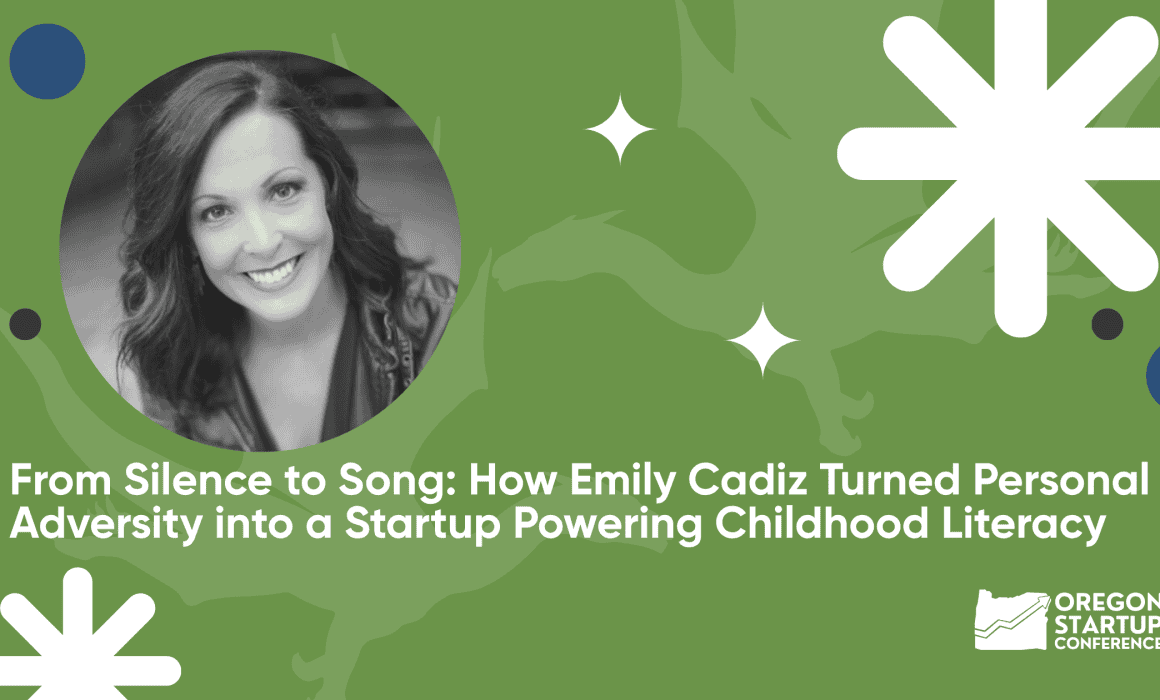
From Silence to Song: How Emily Cadiz Turned Personal Adversity into a Startup Powering Childhood Literacy

When Emily Cadiz lost her ability to speak after a traumatic classroom incident, she faced a deeply personal and professional reckoning.

A lifelong musician and former special education teacher, Emily turned to music to rebuild what had been broken, first in herself, then in the education system.

That journey gave rise to Finnegan the Dragon, an early childhood literacy platform that’s doing far more than teaching kids how to read.

It’s building bridges between science and story, music and memory, education and equity. And that’s exactly why Emily is a powerful addition to the Success Panel of the Oregon Startup Conference on June 20, 2025, at George Fox University.

Using Rhythm and Story to Rewire the Brain

The classroom incident truly brought Emily to what can be argued as the lowest point in her life. She faced financial setbacks because she was unable to teach. She faced personal setbacks because she was unable to communicate.

Throughout that time, Emily found her way back to music. While earning her master’s degree in music, she discovered that music was healing her brain and restoring her ability to communicate.

And as Emily retrained her own brain through music, she discovered something astonishing: that the same techniques that helped her recover her voice could accelerate early language development in children.

That idea became the foundation for Finnegan the Dragon.

The Dragon Searching for His Fire

Finnegan the Dragon is a character that Emily created for her master’s thesis. He’s a dragon who doesn’t have fire, and he needs to go through various adventures so he can find his fire.

Designed for kids ages 2 to 6, Finnegan combines the science of reading with songs, movement, and interactive storytelling. This is not passive screen time. It’s play-based learning with a purpose, where every rhyme, rhythm, and repetition is engineered to reinforce phonemic awareness and cognitive growth.

Finnegan the Dragon quickly caught the attention of education leaders and innovation funders. The platform has received support from the National Institutes of Health, the Eunice Kennedy Shriver National Institute of Child Health and Human Development, and a matching grant from Business Oregon and the Oregon Innovation Council.

Such massive support cements Finnegan’s role as one of Oregon’s most promising edtech ventures.

Finnegan’s Community-Driven Mission

But Finnegan the Dragon is more than a startup. It’s an initiative for literacy justice.

From the beginning, Emily has made sure that Finnegan isn’t limited to families who can afford the latest apps. Through partnerships with Head Start, public schools, and grassroots organizations, Finnegan is reaching children in underserved and multilingual communities, many of whom face barriers to early education access.

Finnegan’s content is culturally responsive and neurodiversity-affirming. This makes it especially effective for kids who are English learners, have learning differences, or come from trauma-impacted backgrounds.

Emily also leads educator workshops to help teachers integrate Finnegan into daily routines and expand their trauma-informed teaching practices. She’s even introduced Finnegan into community healing spaces, transforming music into a tool for emotional resilience and connection.

In every way, Emily is using her platform to ensure that the power of early learning belongs to every child, not just the privileged few.

Meet Emily at the Oregon Startup Conference

Emily Cadiz’s story is one of transformation: personal healing turned into collective impact. Her insights at the Oregon Startup Conference promise to inspire founders, educators, and changemakers alike, especially those who believe that innovation should lift communities, not just markets.

Join us at the Oregon Startup Conference and connect with Emily in person. Learn how she turned music into medicine and a startup into a movement.

Register for the Oregon Startup Conference here.


How Pallavi Pande Is Redefining Disposable Tableware in Oregon’s Startup Scene

In a world awash with disposable convenience, Pallavi Pande saw an opportunity to bring tradition, sustainability, and social impact to the table – quite literally.

As the founder of Dtocs, a Portland, Oregon-based company crafting elegant, compostable tableware from naturally fallen palm leaves, Pallavi is more than an entrepreneur.

She’s a cultural bridge-builder and a changemaker.

A Childhood Memory, Reimagined

Growing up in India, Pallavi cherished the ritual of eating meals on banana leaves, a practice that connected her to nature and community.

Years later, as a mother and businesswoman in Oregon, she transformed that memory into a mission. And that is to replace wasteful paper and plastic disposables with sustainable, stylish alternatives.

In 2019, she launched Dtocs, a play on “detox,” creating single-use plates, bowls, and trays from Areca palm leaves. This tableware is chemical-free, microwave-safe, and compostable within 90 days. They’re available in the US and Canada through their website and retailers like Walmart, Amazon, and Etsy.

A Product that Empowers

Dtocs goes beyond eco-friendly tableware. It’s about empowering people.

The company partners with women artisans in India, providing them with fair wages and resources like sewing machines through collaborations with non-profit organization Anmol Sahara.

In the US, Dtocs supports education equity by donating to organizations like Greater Than PDX.

This dual-impact model earned Pallavi recognition in 2024 as a CO-100 Customer Champion by the US Chamber of Commerce.

A Voice for Founders, A Force for Good

Pallavi’s journey to become a purpose-driven founder is a testament to resilience and vision. Her participation in programs like SEED SPOT’s Retail Brand Accelerator, backed by Walmart.org, has helped scale Dtocs while staying true to her values.

She brings a rare blend of cultural insight, business acumen, and social impact to Oregon’s startup ecosystem. Her story resonates with founders navigating the challenges of scaling a mission-driven brand in a competitive market.

Her insights on building a business that serves both people and the planet are invaluable, whether you’re an aspiring entrepreneur or an established innovator.

Don’t miss the chance to connect with Pallavi Pande at the Oregon Startup Conference, where she is part of the Success Panel. Come and hear how she’s turning leaves into legacy, and learn how you can do the same.

Register for the Oregon Startup Conference here.


5 Pitch Deck Red Flags that Make Investors Walk Away and How to Avoid Them

Picture this: You’ve got the mic, your pitch deck is live, and your startup dream is finally taking the spotlight.

But halfway through your presentation, you notice your investors shifting in their seats, flipping through your deck distractedly or, worse, glancing at their phones.

What went wrong?

Investors aren’t just looking for flashy ideas. They’re looking for signals.

Signals like:

  • Does this founder understand the problem?
  • Can they solve it?
  • Are they capital-efficient?

And your pitch deck often answers those questions, whether you mean it to or not.

Here are five pitch deck red flags that investors currently recognize and how to course-correct before it’s too late. As you prepare for your shot at your next pitch competition, make sure you don’t fall into these common traps.

#1 – No Early Customer Validation

Sure, you’ve got a big idea. But you don’t have customer interviews, prototypes, tests, or traction to back it up.

Why It’s a Red Flag 

Investors don’t want to fund pure theory or dreams. If you haven’t run any experiments, interviewed customers, or done even basic evaluation, it looks like you’re asking them to take all the risks.

How to Fix It

Get scrappy. Talk to users. Run pre-sales. Build a no-code MVP. Even ten conversations or a waitlist of 50 potential customers will show that you’ve started the work and you’re serious about solving a real problem.

#2 – Ignoring the Competition

Stating that you have no competitors doesn’t make your startup seem unique. Instead, it makes it seem naïve.

Why It’s a Red Flag

Every market has alternatives, even if they’re indirect. Failing to acknowledge them suggests a lack of market awareness.

How to Avoid It 

Conduct thorough competitive analyses. Identify your direct and indirect competitors, and clearly explain your differentiators and competitive advantages.

#3 – Top-Down Market Size Only

“We’re in a $100 billion market!” sounds like an impressive claim until it doesn’t.

Why It’s a Red Flag

Top-down numbers, like quoting the global market size from a research report, don’t tell investors how much you can actually capture. It suggests you don’t understand your customer segment or how to reach them.

How to Fix It

Use bottom-up analysis instead. Start with your target customer, estimate pricing, and project realistic adoption rates. Show investors that you know who you’re selling to and how you’ll get to them.

#4 – Unrealistic Financial Projections

If your chart shows hocky-stick growth that defies gravity, you’re not inspiring confidence. You’re raising eyebrows.

Why It’s a Red Flag

Every founder wants to be optimistic. But when projections aren’t tied to a clear strategy or benchmarks, they scream inexperience. Investors wonder if you’ve done your homework or if you’re just winging it.

How to Fix It

Use assumptions grounded in data. Tie projections to sales funnels, acquisition strategies, or pilot results. Show that you understand your costs, margins, and what it will actually take to grow.

#5 – An Overcrowded Team Slide

Did you know that if your team slide looks like a company yearbook, you’re already in trouble?

Why It’s a Red Flag

Investors see a big team and think: high burn rate, low capital efficiency. If you haven’t even validated your product yet, why are you spreading limited capital across so many roles? It also dilutes the perception of leadership. Who is really steering the ship?

How to Fix It

Feature only the essential founding team members, those who are critical to validating the problem, building the MVP, and getting early traction. Advisors or future hires can be mentioned briefly, but the spotlight should be on the core doers.

Your pitch deck is your audition, and investors are sharp judges. These five pitch deck red flags are some of the most common reasons promising startups get passed over.

But the good thing is they’re all fixable.

Before you hit the stage or submit your deck, take time to reflect: Are you telling a clear, credible, and capital-efficient story about your startup?

If the answer isn’t a strong “yes,” then it’s time to revise.

Ready to Pitch Like a Pro?

Apply now to pitch at the Oregon Startup Conference, happening on June 20 at George Fox University.

This is where investors, community leaders, and fellow founders are looking for what’s next in a Shark Tank-like environment. And you could be it.

Show them a pitch deck that’s tight, tested, and ready to win.

Your moment is waiting. Just make sure your deck is too.

At Sacred Fire Creative, we help founders and entrepreneurs build genuine connections with their audience through powerful, authentic brand storytelling. Ready to bring your story to life? Let’s talk about how we can create something impactful together.


The Power of “Done”: Why Speed Is Essential in Business

If you’re waiting until your product is perfect, you’re already too late.

In today’s fast-paced, innovation-hungry world, there is no place for hesitation. Founders and creators often don’t launch their product, service, or idea, not because they want it to be flawless….

It’s often because they think they need one more certification or one more course to validate their idea, or maybe one more polished feature to make it work better. 

But by the time they’re ready, someone else has already launched and learned. And, more often than not, already taken a vast lead.

Paralysis Is the Real Barrier

Let’s be honest. Perfectionism is no longer the goal. Perfectionism has already left the chat.

What’s really stopping most entrepreneurs now is the false belief that they’re not ready yet.

They’re waiting to:

  • Learn a skill they were never meant to master
  • Hire a team they can’t yet afford
  • Build the “best” platform before proving demand

Meanwhile, the market is moving.

That lost time is the difference between being “first to market” and “forgotten.”

Your competitor isn’t better. They’re just braver than you.

The Power of “Done”: Launch Messy, then Listen to Feedback

In startup culture, the minimum viable product or MVP is your best friend.

It’s not about cutting corners. It’s about proving value now. The courage to launch something raw, get real user feedback, and then obsessively iterate is what separates stagnant ideas from scalable businesses.

Here’s what a messy launch gives you:

  • Real feedback, not assumptions
  • Early traction, even if it’s small
  • A seat at a table, while others are still Googling or ChatGPTing how to do it 

Speed matters. Customers pay for solutions, not polish.

When you launch now, you learn:

  • What people will actually pay for
  • Where the friction points are
  • Which assumptions were wrong, and how to fix them fast
  • Whether there’s a true product market fit, or it’s all just a nice idea in your head

Every product you don’t ship is an opportunity you can’t grow from.

Oregon Companies that Chose Speed Over Safety

Let’s look at three local illustrations of “done.” 

#1 – Twenty Ideas: From MVP to Market with Purpose

Based in Eugene, OR, Twenty Ideas is a digital product agency specializing in healthcare, education, and wellness solutions. Their approach emphasizes launching minimum viable products (MVPs) swiftly, allowing for rapid user feedback and iterative improvements. This strategy accelerates time-to-market and ensures the product evolves based on actual user experiences.

#2 – Concentric Sky: Innovating with Open Standards

Also located in Eugene, Concentric Sky is renowned for its swift development of digital credentialing platforms, notably Canvas Credentials, originally known as Badgr. By embracing open technology standards and focusing on rapid deployment, they enabled educational institutions to issue digital badges efficiently. Their agile methodology allowed for continuous enhancements based on user feedback, positioning them as leaders in the digital credentialing space.

#3 – Agility Robotics: Rapid Iteration in Robots

Salem, OR-based Agility Robotics is pioneering the field of humanoid robotics with their product “Digit.” Spun out of Oregon State University in 2015, they adopted an iterative development process, releasing early versions to gather feedback and refine their designs. This approach enabled them to quickly adapt to market needs and establish partnerships with major companies like Amazon for warehouse automation.

Again, it’s not about being ready. It’s about being willing.

Launch what you can now. Let customers teach you what you fix. Improve as you go.

Momentum is more valuable than mastery.

You don’t need to “know more” before you start.

You don’t need the right logo, funnel, or software to launch.

What you need is courage. Speed.

And you need to start so you can learn what actually works, while your competitors are still perfecting something no one asked for.

Launch now. Fix later. Learn faster. That’s how progress wins.

Take Action at the Oregon Startup Conference

Want to see “done” in action?

Attend the Oregon Startup Conference on June 20 at George Fox University. You’ll hear from real founders launching messy, bold, and beautiful things. And you’ll walk away with ideas you can act on now.

Register here to claim your spot.

Sacred Fire Creative specializes in helping founders and entrepreneurs connect meaningfully with their audience through authentic brand storytelling. Contact us today and let’s see how we can collaborate.


Where Big Ideas Take Flight: Highlights from the InventOR Mid-Valley Innovation Jam

Innovation doesn’t always begin in a sleek lab or a bustling tech hub. Sometimes, it starts in a community college classroom, where curiosity meets courage, and an idea becomes something real.

That’s exactly what happened at the InventOR Mid-Valley Innovation Jam, held at Chemeketa Community College on April 23, 2025. More than just a pitch competition, the event was a springboard for student inventors ready to solve real-world problems with bold, practical solutions.

From napkin sketches to polished pitches, teams had just one afternoon to turn imagination into action. The results were nothing short of inspiring.

Meet the winners who brought their A-game:

🥇 PourUp claimed first place with a powerful solution to improve beverage access and efficiency.

🥈 FridgePal impressed the judges with a smart approach to food organization and waste reduction.

🥉 CoreCam took third, demonstrating innovation in safety and monitoring technology.

But beyond rankings and prizes, what stood out most was the spirit of momentum.

These young inventors showed us what’s possible when vision is backed by execution and when a supportive community shows up to cheer them on.

And show up they did. The event was powered by a phenomenal team of volunteers who gave their time and energy to mentor, guide, and run the show: Mike White, Gladys Jadagu, Mohamed Salama, Nick Burgess, Mandy Reininger, Aaron Boston, Joy Boswell, Thomas Berney, and R Taylor. Their dedication created the kind of space where innovation doesn’t just survive, it thrives.

Hosting this movement of ingenuity was Chemeketa Community College, whose continued investment in entrepreneurship is planting deep roots for Oregon’s economic future. Their commitment reminds us that education isn’t just about textbooks. It’s about opportunity.

The Innovation Jam was a message that you don’t need years of experience or a pile of funding to make a difference. What you need is an idea, a team, and the courage to start.

Innovation is alive and well in Oregon’s Mid-Willamette Valley. And if this event was any indication, the future is in good hands.

Be part of the lively and thriving entrepreneurial scene of Mid-Willamette Valley. Start by joining a Coffee Club for Startups and Entrepreneurs near you.


LaunchPad for Non-Techies Virtual Startup Bootcamp: How Non-Techies Are Using AI to Build Their Future

You don’t need to be a developer to be an app creator anymore.

That was the big takeaway from our recent LaunchPad for Non-Techies Virtual Startup Bootcamp, where people with zero technical background turned bold ideas into functional apps using AI tools.

Over the course of two days, this webinar proved that innovation isn’t limited to engineers or developers. It’s for anyone with a problem to solve and the drive to create change.

Our participants came from a variety of age groups and professional backgrounds. Some were young people looking to find solutions that will ease life for their peers. Some were professionals who found gaps they wanted to fill in their industries. Some were entrepreneurs who wanted to make their businesses more efficient and profitable.

What united them was a shared vision. They all saw a lack in the current app market, something that they and their communities needed, and decided to fill that lack themselves.

And they didn’t let the fact that they don’t have a tech background to stop them.

Instead, they learned to leverage AI to turn their ideas into tangible solutions.

The Power of Possibility

Launch Mid-Valley Venture Catalyst Mike White opened the webinar with a powerful perspective.

He recalled how, two decades ago, building an app required hiring a development team, spending tens of thousands of dollars, and months of work – only to end up with a product that might not even launch.

Fast forward to today. With the help of no-code tools like Replit and ChatGPT, Mike took an idea that came straight from a participant and used it to build a working web-based app in just 45 minutes.

It wasn’t a lecture. It was live, real, and interactive. It was the kind of energy that reminds you that anything is possible with the right tools and the right mindset.

Building with Confidence (and Airtable)

To deepen the learning, Clearinity founder Conrad Rohleder joined the webinar to share his approach to app building. He focused on using Airtable to build robust backends for data-heavy apps.

He emphasized two essential lessons for new non-tech founders:

  1. There’s no single AI tool that will solve every problem, so you have to explore and experiment with different tools to see which combination works.
  2. Doing your own research, especially when building your data model, will save you time and money, especially if you later decide to hire a developer.

Conrad’s short talk gave participants the insight to move from “I have an idea” to “I know how to build and structure it using different tools.”

What They Built – and What They Gained

By the end of the Bootcamp, most participants had created their own app prototypes.

But the real success went deeper than that.

They left the weekend with:

  • A better understanding of their business models
  • Clarity around how to monetize their solutions
  • A stronger sense of confidence in their ability to bring ideas to life

And they did it all without writing a single line of code.

What used to take months and thousands of dollars now takes minutes and the right mindset.

Next Stop: Oregon Startup Conference

This momentum is only growing.

We’re bringing that same energy to the upcoming Oregon Startup Conference, happening on June 20, 2025, at George Fox University.

It’s a gathering of innovators, investors, and resource providers from across the state, coming together to inspire, connect, and launch the next generation of businesses.

Whether you’re a founder, a future founder, a resource provider, or just curious about what’s possible in today’s local startup world, this is your chance to see what happens when creativity meets technology.

You’ll walk away with insights, tools, and connections that could change the direction of your journey.

Because if the LaunchPad for Non-Techies proved anything, it’s this: You don’t have to be technical to be transformative.

Register for the Oregon Startup Conference today.

Sacred Fire Creative specializes in connecting founders with their audiences through resource-building and authentic brand storytelling. Do you have a compelling story that you want your audience to know? Contact us, and let’s see how we can collaborate.


Willamette Valley Vineyards: Leading the Future of Wine from Oregon’s Heartland

Tucked among Oregon’s rolling hills, Willamette Valley Vineyards is one of the Pacific Northwest’s most celebrated wineries. It’s recognized not just for its award-winning pinot noir, but also for the values it has brewed into every bottle.

Willamette Valley Vineyards is more than a collection of estates growing grapes for wine. It’s where environmental stewardship, community connection, and bold innovation come together to redefine what a modern winery can be.

From its grassroots beginnings to its industry-shaping leadership, the story of Willamette Valley Vineyards is one of vision, resilience, and deep respect for the land.

A Vision from the Land

The story begins with Jim Bernau, the Vineyards’ founder whose connection to Oregon’s rugged beauty inspired a life-changing dream.

The son of a Roseburg attorney, Jim grew up in Willamette Valley and began experimenting with wine from a very young age. In 1983, he cleared an old plum orchard to grow pinot noir vines. His early days were filled with long hours tending to the vines, even using lengths of garden hoses to water them by hand so they’d survive their first summer.

Jim envisioned a winery that would not only produce exceptional wines but do so in a way that honored the natural landscape and empowered the local community. That vision became a reality when he launched one of the nation’s first community-founded wineries, inviting thousands of wine lovers to become shareholders in Willamette Valley Vineyards.

This democratic approach to ownership helped lay the foundation for a company culture centered on transparency, shared success, and collaboration.

Telling Oregon’s Story Through Wine

Every bottle of Willamette Valley Vineyards wine tells a story of place, people, and possibility. 

The Vineyards champions Oregon-grown grapes, highlighting the diversity of terroir across Willamette Valley and beyond. Their commitment to showcasing local flavors while minimizing environmental impact has helped establish Oregon as a world-class wine destination.

The wines themselves are crafted with intention and precision. But the vineyard’s true legacy lies in its values. The Vineyards has shown that it’s possible to grow a successful business while nurturing the land and the community that supports it. It’s a living case study of how sustainability and social responsibility can be powerful drivers of both purpose and profit.

Cultivating Community and Connection

Community has always been at the heart of Willamette Valley Vineyards.

Their innovative shareholder model has grown to include over 21,000 owners, many of whom serve as brand ambassadors. The Vineyards also supports Oregon-based charities and nonprofit groups, contributing more than $300,000 in goods and services in 2024 alone. Their locations regularly host public events, wine education experiences, and fundraisers, providing a space for connection and celebration.

In February 2025, the Vineyards joined the American Heart Association’s “Life Is Why” campaign across all ten of its locations. Its participation helps raise awareness and funds for heart health. It’s also part of an ongoing mission to give back to the people and places that helped the vineyard flourish.

Sustainability from Ground to Glass

From its earliest days, Willamette Valley Vineyards has prioritized sustainability. That commitment has grown into a sophisticated suite of green initiatives that touch every part of the business, from farming to packaging.

The Vineyards is certified Salmon-Safe, a designation that recognizes agricultural practices that protect local watersheds and aquatic life. It has adopted organic farming techniques, invested in renewable energy, and taken steps to minimize chemical inputs.

One of its most innovative tools is UV-C light technology used in the vineyard to prevent powdery mildew. By using autonomous, electric-powered robots that emit UV-C light at night, the Vineyards can reduce the use of chemical fungicides and limit disease without harming the environment.

In a groundbreaking move toward circular packaging, the Vineyards partnered with Revino in 2024 to offer reusable glass bottles. Their 2023 Whole Cluster Pinot Noir was among the first to be bottled in this sustainable format, allowing each bottle to be reused up to 50 times. This dramatically reduces carbon emissions associated with traditional wine packaging and sets a new standard for sustainability in the wine industry.

These efforts are complemented by renewable energy investments, waste reduction programs, and sustainable construction practices at their tasting rooms and production facilities.

A Legacy Still Growing

Looking to the future, Willamette Valley Vineyards remains focused on deepening its impact. Whether through new sustainability partnerships, expanded community outreach, or continued innovation in the vineyard, the team remains committed to its founding values.

It’s not just about what they produce. It’s about how they produce it – with care for the earth, investment in people, and a belief that wine can be a force for good. In every vintage, Willamette Valley Vineyards invites us to taste not just the fruit of the vine, but the spirit of a community working together to make something truly lasting.

Launch Mid-Valley, the Mid-Willamette Valley Innovation Hub, offers tools, resources, and support designed to help startups and entrepreneurs scale up their businesses.

On April 22, 2025, Domaine Willamette, one of Willamette Valley Vineyards’ ten locations, will be the scene of the Mid-Valley Angel Investors Workshop. This private event is set as an evening of wine, connection, and opportunity, where guests will get exclusive updates from SEDCOR, a peek inside the Mid-Valley Angel Investors Group portfolio, and insights on how to become a better angel investor. Sign up and grab your chance to be in the room where the future happens.

On June 20, 2025, Launch Mid-Valley is hosting the Oregon Startup Conference at George Fox University. It brings together ambitious founders, innovators, community leaders, and investors for a high-energy day of live pitching, networking, and resource sharing.

Be part of the conversation around the future of Mid-Willamette Valley innovation. Register here.

Sacred Fire Creative specializes in helping founders and entrepreneurs connect meaningfully with their audience through authentic brand storytelling. Contact us today and let’s see how we can collaborate.


Privacy Settings
We use cookies to enhance your experience while using our website. If you are using our Services via a browser you can restrict, block or remove cookies through your web browser settings. We also use content and scripts from third parties that may use tracking technologies. You can selectively provide your consent below to allow such third party embeds. For complete information about the cookies we use, data we collect and how we process them, please check our Privacy Policy
Youtube
Consent to display content from Youtube
Vimeo
Consent to display content from Vimeo
Google Maps
Consent to display content from Google